What Is It Like Living in Deercreek, Alpine CA?
What Is It Like Living in Deercreek in Alpine CA?
By Jacob Menath
Deercreek is one of the more recognizable neighborhoods in Alpine CA, especially for buyers looking for larger homes, quiet streets, and an easier transition into East County San Diego living. Its location on the west side of Alpine gives residents noticeably quicker access to Interstate 8 and the rest of San Diego County compared to many deeper Alpine communities, which is a big reason buyers are drawn to it.
If you've been looking at Alpine and trying to figure out which area actually fits how you want to live, Deercreek is worth understanding in detail.
The short version: living in Deercreek tends to attract buyers who want space, privacy, and pride of ownership, but who still want to feel connected to El Cajon, Mission Valley, and central San Diego. It blends larger lots and a quieter pace with a west Alpine location that's noticeably more convenient than deeper parts of Alpine or further east. For a lot of people moving into East County for the first time, that combination is the whole reason they end up choosing Deercreek over other options.
There's more to it, though. The neighborhood has its own rhythm, its own tradeoffs, and a few things that catch buyers off guard if they don't know to ask. Here's what daily life actually looks like, and what to think through before buying in.
Where Deercreek Sits Within Alpine
Deercreek is on the west side of Alpine, close to Interstate 8, with access running off Tavern Road. That alone is a big part of its appeal. You're still in Alpine, still surrounded by the East County foothills and larger properties, but you're not buried deep into the backcountry the way you'd feel further east near South Grade Road or out toward Viejas.
From Deercreek, you can be on Interstate 8 in just a few minutes. Alpine Village, where most of the everyday shopping and dining lives, is a short drive away. So you get the feeling of being tucked into a quiet neighborhood while still having town and freeway access close enough that errands don't become a project.
For people coming from coastal or central San Diego, that geography matters more than it sounds.
The Location Advantage Most Buyers Underestimate
When I talk with buyers who are nervous about moving east, the conversation almost always lands on the commute. People who've lived closer to the coast or in the central county worry about feeling stranded.
Deercreek tends to soften that worry. Because it sits on the west side of Alpine, it can shave roughly ten to fifteen minutes off drives heading toward El Cajon, Mission Valley, or central San Diego compared to homes further east. That depends on traffic and exactly where you're going, but the difference is real and it shows up daily.
That matters in two ways.
The practical side is obvious. Less time in the car. Easier appointments. Less commute fatigue. If you work west of Alpine, or if family lives closer to the coast, those minutes add up over a month.
The emotional side is the one people don't talk about as much. A lot of buyers who move to Alpine carry a quiet worry about feeling "too far out." Deercreek tends to take the edge off that. You still get the larger lots, the quieter streets, and the East County lifestyle, but you don't feel removed from the rest of San Diego. For people transitioning into East County for the first time, that psychological cushion is often the thing that makes the move feel comfortable.
Compared to deeper rural Alpine or backcountry areas, Deercreek feels much less isolated. That's not a knock on those communities. They serve a different buyer. But if you want acreage-style living without the full backcountry feel, Deercreek is one of the more natural landing spots.
What Daily Life in Deercreek Actually Feels Like
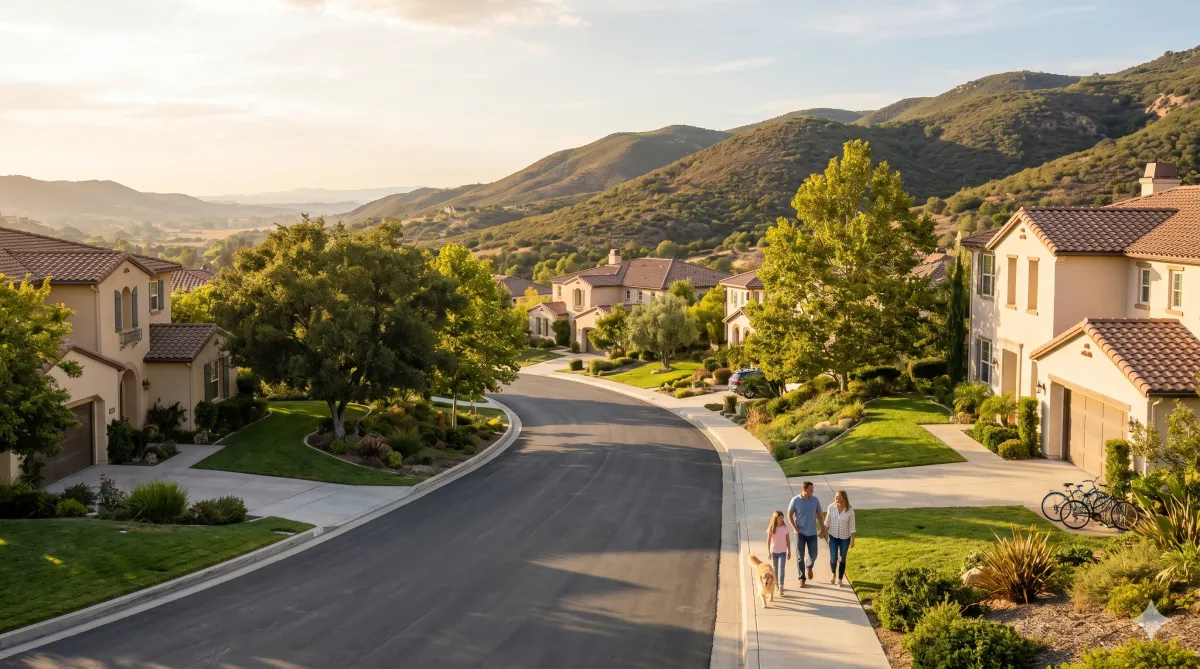
Once you're inside the neighborhood, the first thing you notice is how quiet it is. Traffic is light. The streets stay calm most of the day. You'll see neighbors out walking, working on their yards, or heading out for errands, but you won't get the constant hum of a busier suburban area.
Pride of ownership shows up almost everywhere you look. Homes are generally well kept. Landscaping is established. The neighborhood has a steady, settled feel rather than the in-and-out energy of newer developments.
Walking is a real part of life here. A lot of residents do a loop through the neighborhood that's roughly a mile, give or take depending on the route. The terrain has some gentle hills, enough to give you a workout without feeling punishing, and the long straightaways make it easy to settle into a rhythm. People walk dogs, walk together, walk in the mornings and after dinner. It's quiet enough at both ends of the day that you don't think twice about it.
The community feel follows from that. When neighbors are outside regularly, they tend to know each other. It's not a tightly programmed social scene. It's more the everyday version of a connected neighborhood, where people recognize each other and chat at the mailbox.
The Kinds of Homes You'll Find
Deercreek is mostly larger custom and semi-custom homes on bigger lots than you'd see in a standard tract neighborhood. Driveways are generous. Some properties have RV parking. Some are gated. Architectural styles vary, and you'll see a mix of layouts and lot configurations rather than a cookie-cutter look.
That variety is part of why the neighborhood appeals to people who want space without sacrificing the feel of a real community. You're not in a planned uniform development, but you're also not on raw acreage by yourself. It sits in a middle zone that's actually pretty hard to find in Alpine.
What Buyers Tend to Love Most
When clients buy in Deercreek, the things they end up loving usually come back to a handful of themes.
The quiet. After a few weeks, most buyers comment on how much they notice the calm. Nights here feel genuinely quiet in a way you don't get in denser parts of San Diego County.
The space. Larger homes and larger lots without the maintenance load of full acreage.
The walking culture. People walk Deercreek the same way people in other neighborhoods walk the beach. You'll see folks out in the morning with coffee, dog walkers on the long straightaways, families on bikes after school, and couples doing evening loops once the heat drops. The mile-ish loop through the neighborhood becomes part of daily life pretty quickly.
The mature, lived-in feel. The landscaping has had time to grow in. Trees have filled out. Properties look settled rather than freshly built. Around the holidays you'll see neighbors put real effort into their decorations, and on summer evenings you'll see people out working in their yards or just sitting on their porches.
The location inside Alpine. Closer to Interstate 8, easier to get out, easier to get back. That's a quality-of-life thing every single day.
The room for vehicles. If you own an RV, a trailer, a boat, or a couple of work trucks, Deercreek tends to handle that better than denser neighborhoods.
The sense of identity. Deercreek has a recognizable name and reputation in Alpine, and homeowners feel like part of something specific rather than just a numbered subdivision.
The Tradeoffs Worth Knowing About
No neighborhood fits everyone, and Deercreek has its share of things to think through before you buy.
Guest parking can be tricky. Street parking is generally restricted within the neighborhood, so when you host a larger gathering, you have to plan around it. Most homes offset this with sizable driveways, gated RV pads, or extra on-property parking, but if you regularly host big events with a lot of guests, that's something to talk through before you commit to a specific property.
It's still an East County commute. The location helps, but it's not a coastal address. If your daily life pulls you west of Mission Valley, you'll want to drive it during your actual commute hours before you decide. Maps don't tell the whole story.
Summers run hotter than the coast. Alpine's elevation moderates the heat compared to lower-lying parts of East County, but it's still warmer than what you'd see closer to the ocean. Buyers coming from coastal areas should plan for that.
Larger lots mean more maintenance. More yard. More landscaping. More to keep up. That's part of the appeal for people who want space, but it's a real shift if you're coming from a small lot or a townhome.
Insurance is a conversation. Across East County and the foothills, wildfire-related insurance has become a bigger factor for buyers in recent years. It's not unique to Deercreek, but you should talk to an insurance professional early in your process so you understand what to expect for any specific property. Quotes can vary significantly from home to home, and it's better to know up front than to find out late in escrow.
Who Deercreek Tends to Fit Best
In my experience, Deercreek works especially well for:
People who want a larger home in Alpine without going fully rural.
Buyers who like the idea of a neighborhood feel rather than isolated acreage.
People who walk regularly and want a quiet place to do it.
Owners who need room for RVs, trailers, or extra vehicles.
Buyers transitioning into East County for the first time who want a softer landing.
People who care about pride of ownership and want neighbors who feel the same way.
Who Might Not Love It
Deercreek isn't the right fit for everyone. It tends to be less of a match for:
Buyers who want to walk to restaurants, coffee shops, or retail.
People looking for a small, very low-maintenance lot.
Hosts who regularly need overflow parking for large groups.
Buyers who want a fully rural or off-grid experience on multiple acres.
If any of those describe your daily life, there are other Alpine and East County options that might fit better, and it's worth comparing before you settle on a neighborhood.
Common Mistakes Buyers Make Looking at Deercreek
A few patterns come up again and again when buyers look at Deercreek without enough context.
The first is assuming all Alpine neighborhoods feel the same. They don't. Deercreek, Palo Verde Ranch, Blossom Valley, the more rural pockets, and the areas closer to Viejas all have distinct personalities. Driving through one doesn't tell you what the others are like.
The second is underestimating the parking situation. It seems minor until you host a family holiday and realize the layout matters.
The third is focusing entirely on square footage and ignoring the neighborhood lifestyle. The home itself is only part of what you're buying. The streets, the walking culture, the feel at different times of day, all of it shapes your experience after you move in.
The fourth, which goes with the third, is not spending enough time in the neighborhood before buying. Drive it in the morning. Drive it at dinner. Drive it on a weekend. Get a feel for it the way you'd actually live there.
And the last is assuming all of Alpine is equally convenient to the freeway. It isn't. Where you land inside Alpine genuinely affects your daily commute and your overall sense of how connected you feel to the rest of the county.
What to Sort Out Before You Buy
Before you write an offer in Deercreek, it's worth getting clear on a few things.
Parking rules and how they apply to the specific property. RV parking restrictions if you own one or plan to. The size of the lot and what maintenance it will actually require. Insurance expectations for that particular home, including wildfire-related considerations. Your real commute, driven at real commute times. And the general culture of the neighborhood and whether it matches how you want to live.
None of that is meant to be discouraging. It's just the homework that prevents surprises later.
Frequently Asked Questions
Is Deercreek a good place to live in Alpine? For buyers who want larger homes, quiet streets, and easier freeway access without going deep into rural Alpine, Deercreek tends to be one of the better fits in the area. Whether it's right for you depends on your lifestyle and commute.
Does Deercreek have an HOA? Some sections and properties may have specific governing documents or restrictions, and these can vary. Review the disclosures and any CC&Rs tied to a specific home before making decisions based on assumptions.
Are homes in Deercreek large? Generally yes. The neighborhood is known for larger custom and semi-custom homes on bigger lots than you'd find in a typical tract development.
Is Deercreek walkable? Within the neighborhood, yes. People walk regularly, and there's a comfortable loop of roughly a mile through the streets. It's not walkable to restaurants or retail, though. For that, you'd drive to Alpine Village or beyond.
Does Deercreek allow RV parking? Many properties have RV parking, often gated or set up specifically for it. Restrictions can vary by property and by any governing rules, so confirm before buying if RV storage is important to you.
Is parking difficult in Deercreek? Street parking is generally restricted within the neighborhood, so guest parking takes some planning. Most homes have driveways and extra on-property parking that handle day-to-day needs comfortably, but larger gatherings need a bit of thought.
How far is Deercreek from downtown San Diego? Drive times vary with traffic, but Deercreek's west-side location in Alpine puts it closer to the freeway than many other Alpine neighborhoods, which generally makes the trip to central San Diego more manageable.
What kinds of homes are in Deercreek? A mix of larger custom and semi-custom homes, varied architecturally, on bigger lots. Many have generous driveways, mature landscaping, and room for additional vehicles.
Is Deercreek closer to the freeway than other parts of Alpine? Yes. That's one of its more practical advantages and a big part of why it tends to feel less isolating than deeper Alpine communities.
Is Deercreek considered a luxury neighborhood in Alpine? Deercreek is generally considered one of Alpine's more desirable neighborhoods, with larger custom and semi-custom homes, established landscaping, and strong pride of ownership. Whether any specific home qualifies as "luxury" depends on the property, the finishes, and current market conditions, so it's worth looking at individual listings rather than relying on a label.
Why do buyers choose Deercreek over deeper Alpine communities? The most common reasons are easier Interstate 8 access, the neighborhood feel, and the softer transition into East County living. Deeper Alpine and backcountry areas offer more land and more seclusion, which some buyers want. Deercreek tends to attract people who want larger homes and a quieter pace, but who also want to stay reasonably connected to the rest of San Diego County.
Final Thoughts
Deercreek isn't trying to be everything. It's a specific kind of neighborhood for a specific kind of buyer. If you want larger homes, quiet streets, a real sense of community, and a west Alpine location that keeps you connected to the rest of San Diego County, it's hard to beat within Alpine CA.
For people easing into East County for the first time, living in Deercreek is often the choice that makes the move feel like an upgrade rather than a leap. You get the space and the calm without feeling cut off, and that combination is harder to find than it sounds.
The best way to know if it's right for you is to walk it, drive it at different times of day, and talk with someone who knows the area well. The right neighborhood feels right when you're standing in it. Deercreek either clicks for you or it doesn't, and either answer is useful.
Jacob Menath is a real estate agent in Alpine, CA serving San Diego County, helping homeowners make informed, confident decisions when selling their home and navigating major life transitions.
Menath Real Estate Team | Alpine, CA | Serving San Diego County