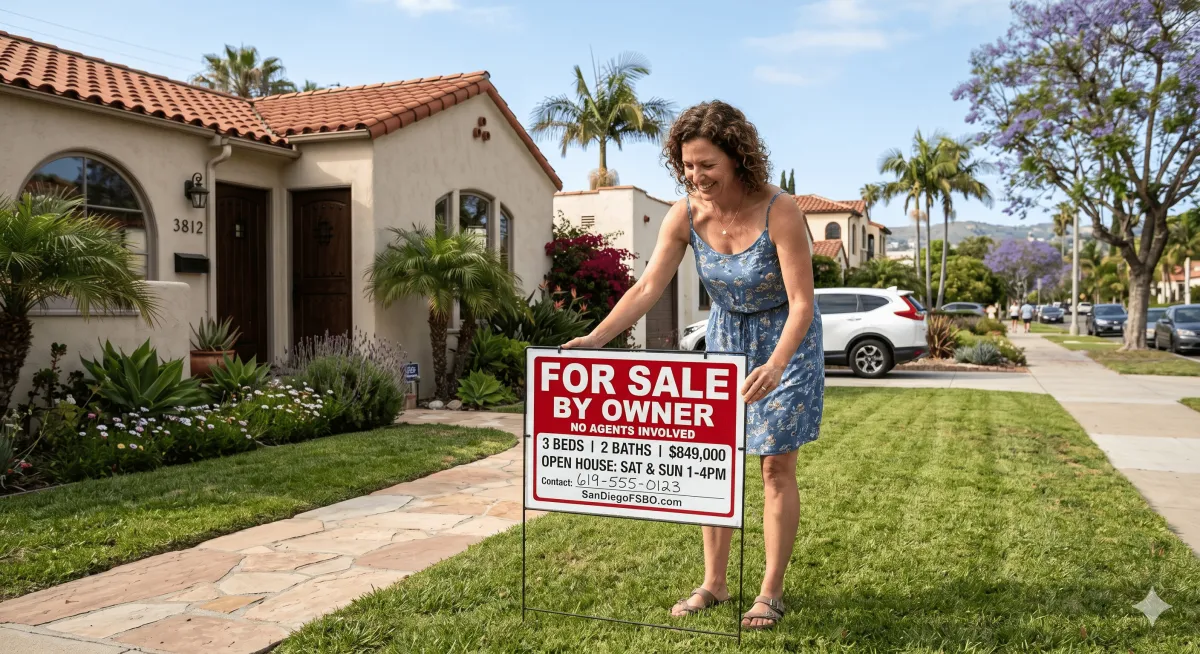
Selling a Home Without a Realtor in San Diego
Selling a Home Without a Realtor in San Diego: What FSBO Sellers Should Realistically Expect
By Jacob Menath
If you're thinking about selling your home yourself, here in San Diego County, the first thing worth saying is simple: you can. It's legal in California, people do it every year, and some of them do it well. Selling without an agent, what most people call FSBO (for sale by owner), is a real option, not a trap.
What catches most sellers off guard isn't whether they're allowed to sell on their own. It's that the hardest moments in a sale rarely happen at the beginning. They show up later, after you're already in escrow, when an inspection report surprises you, the appraisal comes in low, or financing gets shaky two weeks before close. California's disclosure rules are demanding, the San Diego market moves quickly, and properties across East County vary enough that no two sales play out quite the same way.
That's the real subject of this article. Not "you need an agent." Just an honest look at what selling without one actually involves, where it tends to go smoothly, and where it tends to get complicated.
Why some people choose to skip the agent
There are a few common reasons, and most of them are reasonable.
The money. A typical commission represents real dollars on a San Diego home sale. Wanting to keep more of your equity is a completely fair instinct.
A past experience. A lot of sellers have already worked with an agent and walked away feeling like they did most of the work anyway.
A preference for control. Some sellers like answering their own calls, setting their own showing times, and speaking for their own property.
Comfort with the process. Investors and repeat sellers often feel the rhythm of a transaction is familiar enough to handle on their own.
Distrust of the industry. Real estate has a low barrier to entry, and the quality of agents varies widely. A little skepticism is earned.
It's also easier than ever to try. Flat-fee MLS services, online listing platforms, and AI tools have made information and exposure far more accessible than they were even a few years ago. The basic mechanics of selling a home aren't hidden behind a curtain anymore.
I'd rather acknowledge all of that than pretend it isn't true. Some agents provide very little value. And consumers usually know the difference.
A short story that explains a lot
A while back I sat down with a homeowner who was leaning hard toward selling on his own. When I asked why, he told me about the last time he'd sold a house, years earlier.
His agent had him research his own pricing, gave vague answers when asked what the home was worth, and left him filling out most of the paperwork. The agent's main contribution was adding the listing to the MLS and putting a sign in the yard.
He wasn't bitter about it. Just matter-of-fact. He'd basically sold the house himself and paid a full commission for a sign.
I understood completely. If that had been my experience, I'd question the whole thing too.
The point of that story isn't to pile on other agents. It's to explain something important: when people doubt the value of representation, they're usually reacting to a real experience, not an imaginary one. They learned what an agent does by watching one do very little. So the doubt makes sense.
The trouble is that it gives a narrow picture of what the work actually is. A lot of the most important work in real estate happens quietly, after the listing is already live.
Yes, plenty of people can genuinely sell their own home
I want to be clear about this, because it matters.
Some homeowners are well suited to selling on their own. If you're organized, you have time, and you don't rattle easily under pressure, you've already got the core ingredients. Add a straightforward property and a steady market, and a FSBO sale is very doable.
Experienced investors often handle their own deals without blinking. People who've sold several homes already know where the friction points are. Sellers who enjoy negotiating, who can keep their emotions out of it, and who like managing details tend to do fine.
FSBO tends to work best when the property, the timeline, and the personalities involved are all relatively straightforward. When those three things line up, a clean owner-sold transaction is genuinely realistic.
So if part of you is wondering whether you're capable of this, the honest answer is that you very well might be. The capability isn't really the question. The question is what you're walking into, and how much of it you can see from where you're standing right now.
What FSBO sellers tend to underestimate
Here's where I'll be direct, because this is the part that surprises people most.
The marketing is the visible part of selling a home. The sign, the photos, the listing, the showings. It's the part everyone pictures. But the visible part is rarely where deals succeed or fall apart. The complexity of a transaction often has very little to do with how easy the home was to market.
Once you're under contract, here's what tends to show up:
Inspection issues. The buyer's inspector finds a list of items, and suddenly you're negotiating repairs or credits with someone who's gotten nervous about their purchase. Out here in East County, that often includes septic system findings, well water concerns, or roof and exterior issues from sun and wind exposure that bring extra weight to the conversation.
Appraisal issues. The appraisal lands below the agreed price, and you have to decide whether the buyer covers the gap, you reduce, or the deal stalls. Coastal and inland San Diego often price on different psychology, and an appraiser pulling the wrong comps can throw a deal sideways quickly.
Lender issues. The lender asks for one more document, then another, and your closing date starts drifting. Buyer financing has more moving parts than most sellers realize, and small underwriting questions can stretch into real delays.
Disclosure issues. California's disclosure environment is genuinely demanding. Wildfire zone disclosures, natural hazard reports, septic and well disclosures, and any history involving the property all carry real legal weight. What you're required to share, how you word it, and what you might unknowingly leave out can create exposure that doesn't show up until well after closing.
Then there's the human part. Buyers get emotional. Sellers get emotional. Negotiations that should be about numbers turn into something that feels personal. Staying calm and clear-headed while it's your house and your money on the line is harder than it sounds.
None of this is meant to scare you. It's just the honest map. The early steps of a sale are the ones you can study and prepare for. The later steps depend on judgment in the moment, often with incomplete information and a clock running.
That's the core of it. Some people absolutely can sell their home themselves. The challenge is that many of the hardest parts of a transaction don't reveal themselves until you're already deep into escrow.
What a good agent is actually for
This is where I'd push back gently on the "they just list it and put up a sign" idea.
Anybody can get a home onto the MLS. That part is not hard, and it's not where an experienced agent earns their place. If listing a home were the whole job, the skepticism would be entirely correct.
The real value is harder to see because it's mostly judgment:
Pricing a home to reflect what's actually happening in your specific pocket of the county
Reading buyer behavior and sensing whether an offer is solid or shaky
Handling inspection negotiations so they don't blow up
Structuring offers thoughtfully and anticipating appraisal problems
Guiding disclosures carefully to protect you
Managing timing so the moving parts line up
Staying steady when everyone else in the deal is stressed
Most experienced agents spend far more time managing uncertainty than marketing homes. That's the real work most sellers never fully see from the outside.
The best agents aren't valuable because they can put a home on the MLS. They're valuable because they help people make better decisions when the stakes are high and the situation is moving fast. That's a different skill entirely, and it's the one that's hard to see until you need it.
The blueprint is not the same as the experience
Information has never been easier to find. Seller checklists, step-by-step guides, YouTube walkthroughs, pricing websites, AI tools, downloadable contracts. You can learn the mechanics of a home sale in an afternoon if you want to.
That's genuinely a good thing. An informed seller is a better seller, whether they hire someone or not.
But information is easier to access than judgment. A playbook tells you what's supposed to happen. It doesn't tell you what to do when something happens the playbook didn't predict. And in real estate, the hardest calls tend to come quickly, emotionally, and with information you don't fully have yet.
You can read every guide out there and still hit a moment where the right move isn't obvious. Experience is mostly about having stood in that exact spot before and knowing, from having lived it, which way tends to go wrong.
If you're set on selling it yourself
If you've read this far and you're still committed to FSBO, good. Let's make you better at it. Here are the areas worth taking seriously before you start:
Get serious about disclosures. Understand what California expects you to share, and don't treat it as a formality. This is where small mistakes create the biggest exposure.
Learn the contract process before an offer shows up. Know what the contingencies mean, what the timelines are, and what each deadline triggers. Surprises in a contract are almost always expensive.
Study pricing carefully. Look at genuinely comparable homes, not just whatever's nearby. In East County, two homes a few miles apart can be very different animals once you factor in acreage, well versus public water, septic, road access, and insurance considerations.
Decide how you'll handle buyer-agent compensation. Most buyers are still working with an agent, and how you address their commission affects how many of them seriously consider your home. Be clear, in writing, about what you're willing to offer.
Build a real showing access strategy. Decide in advance how showings will be scheduled, who you'll show to, how you'll verify a buyer is qualified, and how you'll keep your home secure. Improvising this in the moment causes most of the friction FSBO sellers complain about.
Take presentation seriously. Professional photography, clean staging, and a well-prepared home make a measurable difference. Many FSBO sellers underestimate how much presentation quality affects buyer confidence, especially in a market where buyers compare your home side by side with professionally marketed listings.
Prepare for the inspection negotiation. Decide ahead of time how you'll handle repair requests, what you're willing to credit, and where you'll hold the line.
Keep your paperwork organized from day one. Disclosures, receipts, permits, prior reports, warranties. The sellers who struggle most are usually the ones improvising as they go.
One more thing worth saying plainly: the buyers most comfortable purchasing directly from an owner are not always the buyers who create the smoothest escrows. Some are excellent. Others are looking for a softer negotiation or assume a FSBO seller doesn't know the local market. Knowing the difference takes practice.
I also keep free resources available for sellers, including seller guides, an informed-seller book, and listing strategy materials. They're useful whether you hire me or not. Understanding how a strong listing strategy works makes you a sharper seller either way.
What surprises FSBO sellers the most
When I talk to people who've sold on their own, the same themes come up:
How emotional the negotiations get, on both sides
How much communication the process demands, day after day
How many problems appear after escrow opens, not before
How hard pricing is to get right, and how much a small miss costs later
How stressful it feels when your own home is being picked apart in an inspection
How much a buyer's financing can delay or sink a deal
How quickly small mistakes compound once the clock is running
A lot of FSBO sellers expect the accepted offer to feel like the finish line, when it's usually the point where the transaction becomes most fragile.
When FSBO actually makes good sense
I'm not going to pretend representation is always the answer, because it isn't. FSBO often makes real sense when:
You're an investor selling to another investor
It's an off-market deal between people who already know each other
You're transferring a property within the family or to a trusted private party
You've already got a direct relationship with a willing, qualified buyer
You're an experienced seller who's done this several times and the property is straightforward
Inherited family transfers and trusted private-party sales are some of the cleanest FSBO scenarios out there, because the trust and the terms are usually already in place before paperwork even begins. In those cases, going it alone isn't a risk. It's just a reasonable choice.
When representation usually matters most
There are also situations where having someone experienced in your corner tends to make a real difference, and most of them have nothing to do with marketing:
Emotionally difficult sales like divorce, probate, or an inherited family home
Complicated properties common in the foothills and rural areas: acreage, horse properties, well and septic systems, wildfire insurance questions, and unusual road access
Luxury and unique homes, where the buyer pool is smaller and pricing has to be defended carefully
Out-of-area sellers managing a sale from a distance, where logistics and decision-making get harder
Multiple-offer situations, where choosing the right offer matters as much as the highest number
Deals with major repairs or messy inspections
Timing-sensitive moves, where you're buying and selling at once and a misstep on one side throws off the other
Some of the hardest transactions have nothing to do with the property itself and everything to do with the emotions, timing, or personalities involved. Those are the moments where judgment earns its keep.
Frequently asked questions
Can I legally sell my house without a realtor in California? Yes. California allows owners to sell their own property without hiring a licensed agent. You're responsible for the disclosures, contracts, and legal requirements that come with the sale, but there's no law requiring you to use a realtor.
Is FSBO common in San Diego? It happens regularly, though it's a minority of sales. You'll see it more often with investors, off-market deals, and experienced sellers than with typical move-up or downsizing sellers.
Do FSBO sellers save money? Sometimes. Skipping a listing commission can save real money. But the net depends on your final sale price, how the negotiation goes, and whether any costly mistakes come up along the way. Some sellers also underestimate how pricing mistakes or negotiation issues can quietly offset commission savings.
Should I offer buyer-agent compensation if I sell FSBO? You're not required to, but it's worth thinking carefully about. Most buyers are still working with an agent, and homes that openly offer buyer-side compensation tend to draw more serious interest. If you choose not to offer it, you'll want a clear plan for how you'll handle agent-represented buyers who do show up.
Can a FSBO seller still use escrow and title companies? Yes. Escrow and title services aren't tied to whether an agent is involved. You can open escrow, order title, and close through a neutral third party just like any other transaction. Many FSBO sellers rely heavily on their escrow officer to keep the paperwork on track.
Do buyers trust FSBO listings? Some do, some don't. Experienced buyers and investors are often comfortable with FSBO. Less experienced buyers, or buyers whose agents steer them toward fully represented listings, can be more hesitant. Strong presentation, organized disclosures, and clear communication help a lot.
What are the biggest risks of selling without an agent? Usually disclosure mistakes, pricing missteps, and trouble managing the parts of the deal that happen after you're under contract: inspection negotiations, appraisal gaps, and financing delays.
Can I put my home on the MLS without a realtor? Not directly. The MLS is accessed through licensed members. Some sellers use a flat-fee listing service to get onto it, though that typically only covers the listing itself and not the guidance through the rest of the transaction.
What paperwork is required to sell a home in California? A purchase agreement, the required state and local disclosures, and various escrow and title documents. The disclosure requirements in particular are detailed, and getting them right matters well beyond closing day.
What happens if problems come up during escrow? That's where most deals are won or lost. Inspection issues, low appraisals, lender delays, and contingency questions all tend to surface after the offer is accepted, and how you handle them shapes whether the deal closes and on what terms.
Why do some people choose FSBO? To save on commission, to keep control of the process, because they've sold before and feel comfortable, or because a disappointing past experience with an agent left them questioning the value.
What do listing agents actually do beyond marketing? The real work is pricing judgment, negotiation, disclosure guidance, inspection and appraisal navigation, managing timing and the many moving parts, and keeping the deal steady when things get stressful. Listing the home is the small, visible part.
When does hiring an agent usually make the biggest difference? In emotionally difficult sales, complicated or rural properties, luxury or unique homes, multiple-offer situations, deals with significant repairs, and timing-sensitive moves where a lot is happening at once.
A few final thoughts
If you take one thing from all this, let it be this: there's nothing wrong with questioning the value of an agent. A lot of sellers ask that question because of a real experience, and they're not wrong to ask it. Some people absolutely can and should sell their own home, and I'd rather tell you that honestly than talk you out of it.
But it's worth seeing the work clearly before you decide. The value of good representation was never about the sign or the MLS. It's about judgment, negotiation, and steady decision-making when the stakes are high and the situation is moving fast. That part stays invisible right up until the moment you need it, which is usually somewhere in the middle of escrow.
California transactions are paperwork-heavy, San Diego pricing can shift quickly, and East County properties bring their own layers of complexity that don't apply to a standard tract home. None of that makes FSBO the wrong choice. It just means the decision deserves real thought.
Whether you hire representation or sell on your own, the sellers who usually have the best outcomes are the ones who understand where the real pressure points in a transaction actually are before they get there.
Jacob Menath is a real estate agent in Alpine, CA serving San Diego County, helping homeowners make informed, confident decisions when selling their home and navigating major life transitions.
Menath Real Estate Team | Alpine, CA | Serving San Diego County