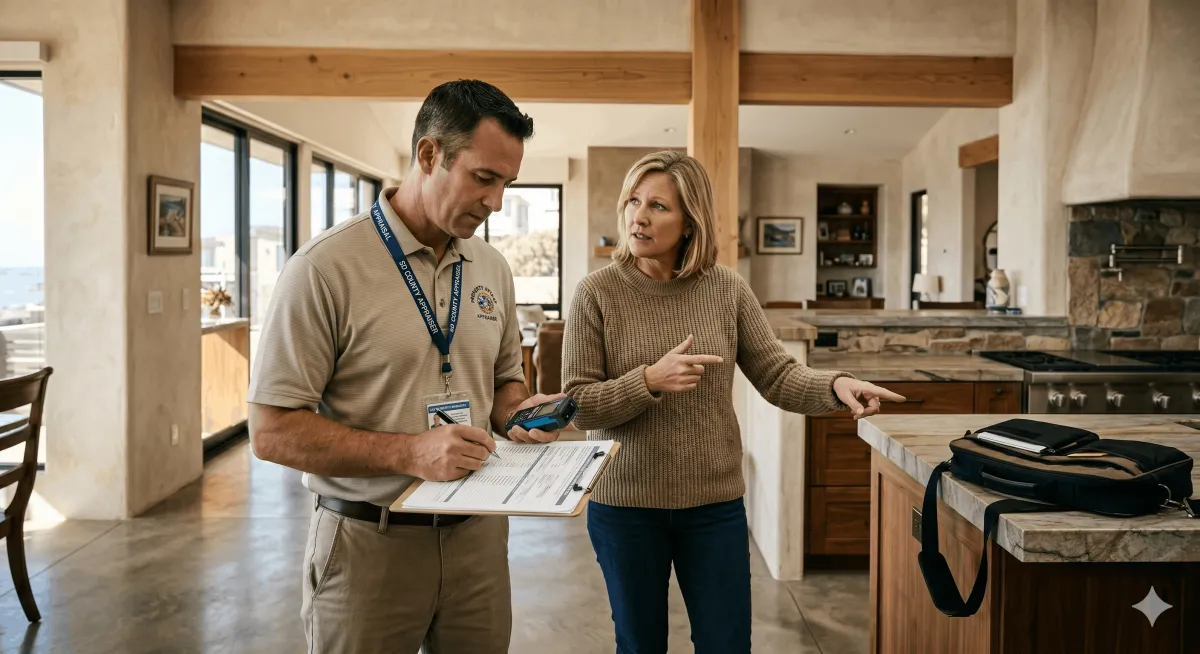
What Not to Say to an Appraiser in San Diego
What Not to Say to an Appraiser When Selling in San Diego
By Jacob Menath
The appraisal appointment is one of those moments where sellers either help themselves or quietly hurt themselves, and most don't realize which they're doing until it's too late.
Here's the short version: an appraiser's job is to form an independent opinion of value. They are not your buyer's advocate. They are not your agent. They are a neutral third party hired to look at your home and compare it to what else has sold nearby. Anything you say that feels like lobbying can actually work against you.
A lot of homeowners think they need to "help" the appraiser reach the number. In reality, pushing too hard usually creates skepticism instead of confidence.
That said, there are things worth communicating and things you should keep to yourself.
What Not to Say
"We need to hit [a specific number] to make this deal work."
This is the most common mistake. The moment you tell an appraiser what the home needs to appraise for, you've shifted from informing to pressuring. Even if they don't react visibly, you've introduced an awkward dynamic. Their job is to be objective. Let them be.
"We put so much money into this place."
Renovation costs do not equal appraised value. A $40,000 kitchen remodel doesn't automatically add $40,000 to your home's value. What matters is what comparable homes with similar upgrades have sold for in your market. Mentioning what you spent can set up a disconnect, and if the number comes in lower than your investment, the conversation gets uncomfortable fast.
In East County markets like Alpine, Santee, and Lakeside, this is especially common with homeowners who've done significant custom work. Custom doesn't always mean comparable.
"The Zestimate says it's worth more."
Zillow estimates are algorithmic. They don't account for your specific lot, your layout, your condition, or what's actually closed nearby. An appraiser knows this, and bringing it up signals that you may not fully understand the process. It doesn't help you.
"Our neighbors got [X amount] for theirs."
Neighbors talk. Sometimes they're right, sometimes they're not. The appraiser already has access to the same MLS data you're referencing. If that sale supports your value, they'll use it. If it doesn't, because of different square footage, condition, or lot size, pointing to it doesn't change anything.
Anything emotionally charged about your attachment to the home.
This is a normal human impulse. You raised kids here, built memories, put your heart into it. That's real. But the appraiser can't factor it in, and trying to appeal to sentiment doesn't move the number. Save that energy for your next chapter.
What You Should Do Instead
This is where you can actually make a difference.
Prepare a one-page summary of improvements.
Date, description, approximate cost. Be factual and concise. A new roof in 2022, HVAC replaced in 2021, solar system installed with battery backup. These are legitimate data points. You're not lobbying. You're informing.
Have permit records available.
If work was done with permits pulled and inspections completed, that matters. It tells an appraiser the work was done to code. Unpermitted work, on the other hand, can create complications. Better to know that in advance than be surprised.
Point out anything that isn't obvious at first glance.
Maybe your garage has a finished space that doesn't show clearly. Maybe there's an additional storage room, a newer water heater tucked in a corner, or a newer panel upgrade. Walk-throughs are sometimes fast. A brief, factual mention helps.
Give them space to do their job.
You don't need to follow the appraiser room to room or explain every design choice. Be available, be friendly, answer questions directly. Then step back.
A Quick Note on Timing
If you're downsizing in San Diego County, or moving up and your current home's appraised value is tied to your next purchase, the stakes here are real. A low appraisal can stall or kill a deal. That's why preparing ahead of time, not scrambling during the appointment, is the move.
Common Mistakes, Summarized
Sellers tend to overcommunicate in ways that don't help: sharing what they paid for renovations, what they need the number to be, or what Zillow says. None of that moves an appraiser. What does help is organized documentation, permit records, a calm walkthrough, and letting the comparable sales do the talking.
The appraisal is not a negotiation. Trying to turn it into one is where a lot of sellers unintentionally hurt themselves.
The better you understand that distinction, the more confident you'll feel going into it.
Jacob Menath is a real estate agent in Alpine, CA serving San Diego County, helping homeowners make informed, confident decisions when selling their home and navigating major life transitions. If you're preparing to sell and want clarity on pricing, preparation, or the appraisal process, reach out to the Menath Real Estate Team for a straightforward conversation.