Selling a Home With Solar Panels in San Diego
Selling a Home With Solar Panels in San Diego: What Sellers Need to Know Before Listing
By Jacob Menath
If you're getting ready to sell a home with solar in San Diego County, here's the short version. The panels rarely make or break a sale on their own. What slows a deal down is usually the stuff around them: a loan nobody fully understood, a lease with murky transfer terms, missing paperwork, or a price expectation the market won't support. Get those handled before you list, and the solar tends to fade into the background. Sometimes it even works in your favor.
I lead with that because sellers tend to assume the opposite, often in both directions at once. Some are sure the panels guarantee a faster, higher sale. Others have heard a horror story and worry the system will scare buyers off. In this county the answer usually lands in the middle, and where it lands comes down to how prepared you are before the sign goes in the yard.
That preparation matters even more inland. In East County communities like Alpine, El Cajon, Lakeside, and Jamul, buyers tend to pay close attention to utility costs, because larger homes, hotter summers, and heavier AC use can make electric bills far more noticeable than they are near the coast. Solar is common across Southern California, but out here it often carries real weight in a buyer's math. They're not wondering what solar is. They're wondering what your solar costs them, who owns it, and whether it's an asset or an obligation they're about to take on.
So if you take one thing from this, take this: the panels are usually fine. It's the unanswered questions that create friction. Here's how to keep those from turning into problems.
Not all solar setups are the same
This is the part a lot of sellers breeze past, and it shapes your whole sale more than anything else. "I have solar" can mean three pretty different things to a buyer, and each one comes with its own conversation.
Why owned solar is usually simplest
If you paid cash or already paid off the system, there's no monthly payment to transfer and nothing the buyer has to qualify for. They just inherit lower utility costs, which is an easy thing to like in a county where SDG&E bills get plenty of grumbling. Even so, "owned" doesn't mean "no work." Have your proof of ownership or payoff, the install records, and the warranty info ready to hand over. Buyers and their agents will ask.
What financed solar changes
The panels are yours, but there's a loan attached, and that brings a few predictable questions. Will it be paid off at closing? Can the buyer assume it? What's the monthly payment, and for how long? None of these sink a deal by themselves. The trouble starts when the seller doesn't actually know the answers. If you have to go hunting for your payoff amount mid-escrow, you've turned a five-minute question into a week-long delay. Know your numbers before you list.
Why leased solar creates more questions
With a lease or a PPA (power purchase agreement), the buyer isn't buying the panels. They're agreeing to step into your contract. So they want to understand the transfer process, whether they need to qualify with the solar company, the monthly obligation, and how long it runs. Plenty of buyers are fine with that once it's laid out plainly. Others hesitate simply because nobody gave them straight answers.
I've seen sellers assume a buyer would happily take over a solar lease, only to find midway through escrow that the buyer wanted far more detail on transfer terms and monthly obligations than anyone expected. Once the paperwork was organized and walked through, the hesitation settled down fast. The lease was never the issue. The fog around it was.
That thread runs through all three setups. What matters most isn't whether your system is owned, financed, or leased. It's whether you can explain it cleanly when someone asks.
Questions to ask yourself before listing
Before you ever talk to a buyer, run through this quick self-check. If you can answer all of these without hunting, you're in good shape.
Is the system owned, financed, or leased?
If financed, what's the payoff amount?
If leased, can the agreement transfer easily, and what does the buyer have to do?
Do I have the warranty paperwork and installer info?
How old is the roof under the panels?
What have the recent utility bills actually been?
Most solar friction in a sale traces back to one of these going unanswered. Clearing them up front is some of the highest-value prep you can do.
The paperwork to pull together before you list
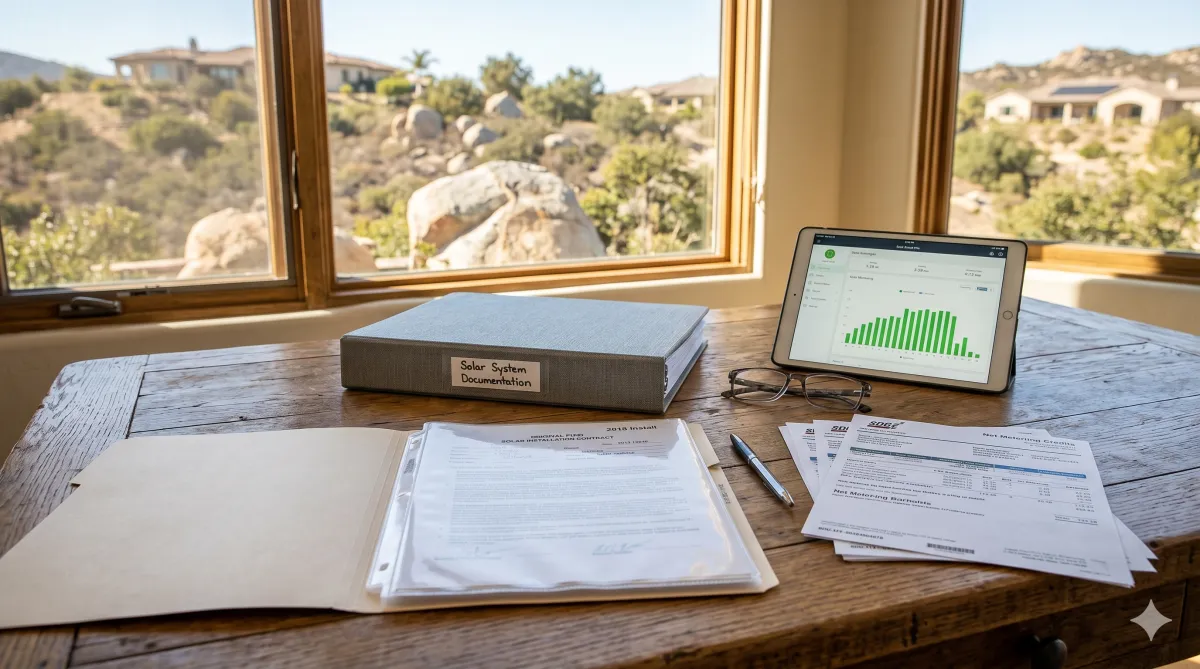
If I could get every solar seller to do one thing early, it'd be this. Gather your paperwork before you're under contract and the clock is running.
The list isn't long:
The solar contract or purchase agreement
Loan or lease documents, if you have either
Warranty information
Installer name and contact info
A few recent utility bills
Monitoring app or account details
Proof of ownership or payoff, if it applies
One of the most common delays I see has nothing to do with the panels. It's a seller scrambling to find a contract they signed six years ago, from a company that may not even be around anymore. Escrow timelines are tight. When a buyer's agent asks for lease transfer terms and it takes ten days to track them down, that's ten days of a nervous buyer wondering what else they don't know. A simple folder, digital or physical, quietly heads off a problem most sellers never see coming. It's the same logic behind preparing your home for sale in general: do the easy work early so it isn't hard work later.
A recent transaction that shows why this matters
A recent sale we handled in San Diego County is a good example of how solar can create escrow problems even when everyone believes they've done things correctly.
The sellers had a high-end owned solar and battery system, installed through a company one of them was personally connected to, so this wasn't a household new to how solar works. Before buying the home, they believed they'd confirmed the solar loan would transfer to a future buyer if they ever sold.
When the property went into escrow, the plan was simple: the buyer would assume the loan along with the panels. Then, partway through, that plan came apart. The loan turned out not to be transferable, despite what the sellers understood they'd been told at the start. The buyers were uncomfortable taking on a solar obligation they hadn't expected, and the sellers didn't want to surrender a large portion of their proceeds to pay it off.
The deal still closed. We restructured the situation and paid the solar loan off through escrow. But it cost everyone a stretch of avoidable stress that one phone call months earlier would have prevented.
These were knowledgeable owners who genuinely believed they had it handled, and the system itself was excellent. The panels were never the problem. The issue was an assumption about transfer terms that nobody had verified in writing before listing. One of the biggest mistakes sellers make is assuming the information they were told years ago about their solar loan or transfer terms is still accurate without verifying it directly before listing the home.
What sellers misunderstand most about solar
After enough of these sales, the same handful of assumptions show up again and again. If any of these sound familiar, they're worth checking before you list:
Assuming a solar loan transfers automatically. Some do, some don't, and the terms aren't always what you remember being told.
Assuming buyers will value the system dollar-for-dollar with what you paid. They price what's in front of them today.
Assuming an owned system needs no documentation. Buyers and appraisers still want records and proof.
Assuming every appraiser treats solar the same way. They don't, especially across owned, financed, and leased setups.
Waiting until escrow to verify the details. By then a small question has room to grow into a real holdup.
None of these are signs of a careless seller. They're just easy assumptions to make, which is exactly why they catch people.
What buyers actually care about
Here's something that catches sellers off guard. Most buyers don't care about the panel brand or the inverter model or the specs you could recite in your sleep. They care about how it affects their life and their wallet.
What they're really asking, even when the wording changes, is pretty consistent:
What are the average electric bills here?
Is the system owned, financed, or leased?
Is there a loan or payment I'd take on?
How old is the system?
Was the roof replaced before the panels went up?
What happens if something needs repair?
In hotter inland parts of San Diego County, buyers lean on that first question hard, because summer cooling costs add up fast on larger homes with more square footage. This becomes especially noticeable on bigger East County properties, where summer cooling costs can run dramatically higher than a smaller coastal home. A system that takes a real bite out of an SDG&E bill is something buyers notice.
A couple of things increasingly come up alongside the basics. Battery systems add another layer of questions around warranties, backup capability, and transfer documentation, especially as battery storage becomes more common across San Diego County. And some buyers will ask whether the system runs on an older NEM agreement or utility structure, since that can affect how they weigh long-term utility savings.
The cleaner you can answer all of this, the smoother things go. Vague answers make buyers cautious. Solid ones build confidence.
Does solar actually increase home value?
This is the question I get most, and it deserves an honest answer instead of a sales pitch.
Solar can genuinely help your home's appeal in San Diego, especially given how high utility costs run here. A buyer staring down years of SDG&E bills, or thinking about running AC hard through an East County summer, often sees real value in a system that softens that. That interest is real.
But "helps appeal" and "adds X dollars" are two different things, and anyone who promises a specific number is guessing. The value impact depends on a lot: whether the system is owned, financed, or leased; the age and condition of the panels; how a buyer perceives it; the quality of the original install; the roof underneath; and what's normal for homes in your area. Appraisers don't always evaluate solar the same way either, particularly when comparing owned, financed, and leased setups.
Expectations also shift by price point and neighborhood. In some newer San Diego County developments or higher price ranges, buyers almost expect to see solar, and its absence stands out more than its presence. In other situations, especially with an older or leased system, buyers weigh it far more cautiously. A newer owned system on a sound roof reads very differently than an aging leased one with a long contract still attached. Both can sell well. They just won't move the price the same way. Think of solar as something that can strengthen your home's position and widen its appeal, not as a guaranteed line item you'll get dollar-for-dollar at closing.
Where escrow tends to get bumpy
Most solar-related stress in escrow comes from a short list of recurring situations, and nearly all of them are preventable. A buyer gets cold feet about a lease they don't understand. Payoff information turns out to be hard to pin down. Documentation goes missing right when it's needed. An appraisal raises questions about how the system was valued. The roof comes up, and there's sudden worry about what's under the panels.
What ties these together is that they're surprises, and surprises rattle buyers. When information arrives late or fuzzy, people fill the gap with worry. When it arrives early and complete, the same issue barely registers. Getting ahead of it handles most of this before it becomes anything.
Roof condition matters more than sellers expect
This one catches people off guard. When you have solar, buyers don't just ask about the panels. They ask about the roof under them.
The reason is practical. Panels sit on top of a roof, and if that roof needs replacing later, they have to come off and go back on, which adds cost. A sharp buyer, or a thorough inspector, will think about that. So if your roof is older, or the panels went on top of a roof that was already aging, expect questions.
You don't need to solve every hypothetical. Just know your roof's age and have records if you can find them. Being able to say "the roof was done the year before the panels, here's the documentation" turns a worry into a non-event. This comes up more often when you're selling older rural homes in East County, out in the foothills, where roof age and exposure are already on a careful buyer's mind alongside things like wildfire insurance and road access. A little preparation goes a long way.
What you can do to make the sale smoother
None of this is complicated. It's mostly about sequencing.
Before you list:
Gather your paperwork into one place
Know your payoff or lease terms cold
Know how old the system is
Have a realistic sense of the utility savings
Anticipate the questions buyers will ask
While it's on the market:
Explain the system simply
Resist the urge to oversell it
Lead with transparency over hype
Present the utility savings honestly, not optimistically
Once you're in escrow:
Respond quickly when solar questions come up
Get documentation to the other side early
Keep surprises off the table
That last column is where deals get quietly saved. Speed and straight answers reassure everyone, including your own agent.
What surprises sellers most
After enough of these transactions, you notice patterns that have nothing to do with the technology.
The first is how many questions solar generates. Sellers expect the panels to be a simple plus, then they're surprised by how much buyers want to dig in. That's not a bad sign, just buyers being thorough about something they'll live with.
The second is how differently buyers react to owned versus leased systems. Two homes with identical panels can draw completely different responses based purely on whether a contract is attached. The hardware is the same. The feeling about it isn't.
The third, and the one I'd most want you to hear, is how often the paperwork ends up being the real story. Not the panels. The folder, or the missing folder.
Frequently asked questions
Does solar increase home value in San Diego? It can help your home's appeal, especially given how high utility costs run here, but the dollar impact varies and isn't guaranteed. Age, condition, owned versus leased, roof condition, and how an appraiser treats it all play a role. Think of it as a potential strength, not a fixed price bump.
Is owned solar better than leased solar when selling? Owned systems are usually simpler at resale because there's no contract for the buyer to take on. Leased systems can still sell well, but they need more explanation and clear transfer documentation so the buyer knows exactly what they're agreeing to.
Do buyers assume solar loans? Sometimes, depending on the loan and the lender's rules. It's not automatic. Know your loan terms ahead of time, including whether it can be assumed and what the payoff would be, so you can answer cleanly when it comes up.
Can leased solar make a home harder to sell? It can add friction, but usually only when the terms aren't well understood. Buyers hesitate at missing information, not at the lease itself. Solid documentation and a plain explanation resolve most of it.
What paperwork do I need for solar panels? At minimum: your solar contract, any loan or lease documents, warranty info, the installer's details, a few recent utility bills, monitoring account access, and proof of ownership or payoff if it applies. Gather it before you list.
Should I pay off my solar loan before selling? That depends on your finances and your loan terms, and it's worth a conversation with your agent and possibly a financial professional. Sometimes paying it off simplifies the sale, sometimes it doesn't make sense. What matters most is knowing your options before you're under contract.
Should I remove solar panels before selling? In most cases, no. Removal is expensive, can affect the roof, and strips out savings many San Diego County buyers actually want. The far more common fix is documentation and straight answers, not taking the system down. There are occasional exceptions with very old or non-functioning systems, so it's worth talking through with your agent before deciding.
What happens if the solar company goes out of business? The panels keep producing power regardless. What can change is who handles warranty claims, monitoring, or service, which is why this comes up more with older installs. Third-party companies often service orphaned systems, and keeping your original paperwork makes that far easier. If your installer is no longer around, it's worth flagging for buyers up front so it isn't a surprise later.
Do buyers care about electric bills in San Diego? Very much. With our utility costs, and heavy AC use through East County summers, buyers regularly ask about average bills. Solar that meaningfully lowers them is something they notice.
What happens if the roof needs replacement after solar installation? The panels generally have to be removed and reinstalled, which adds cost. That's why buyers ask about roof age when there's solar. Knowing your roof's condition and having records available keeps it from becoming a sticking point.
Final thoughts
In San Diego County, solar has become common enough that most buyers are comfortable with it when the details are spelled out. Agents work with it all the time, buyers are used to seeing it, and on its own it rarely derails a deal.
The sellers who struggle most with solar usually aren't the ones with the worst systems. They're the ones who assumed everything would work itself out later. The smoothest escrows tend to belong to sellers who verified the details early, organized the paperwork before listing, and treated solar as part of the transaction instead of an afterthought. Solar doesn't get in the way of a sale. Lack of preparation does.
If you're thinking through a move, whether it's a home in East County or a rural property with more land to weigh, it's worth planning the solar piece before anything goes sideways rather than after.
Jacob Menath is a real estate agent in Alpine, CA serving San Diego County, helping homeowners make informed, confident decisions when selling their home and navigating major life transitions.
Menath Real Estate Team | Alpine, CA | Serving San Diego County