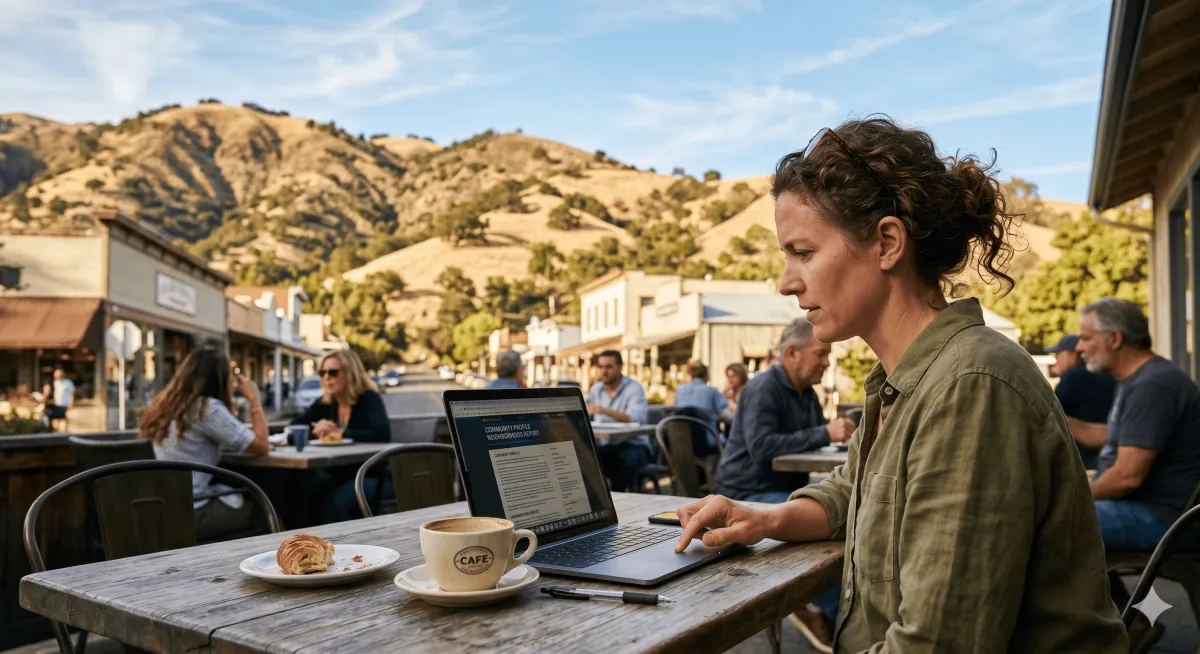
What Are the Demographics of Alpine CA?
What Are the Demographics of Alpine, CA?
By: Jacob Menath
If you're thinking about a move to Alpine, you're probably trying to picture what the community actually looks like and who tends to settle here. That's a fair thing to want to know before you uproot your life and point a moving truck east.
But here's something I've noticed after years of working with buyers and sellers in this area. When people ask about demographics, they're rarely after a spreadsheet. They're really asking a bigger, more human question:
"What is it actually like to live in Alpine?"
I'm Jacob Menath with the Menath Real Estate Team in Alpine, California, and I help buyers and sellers across Alpine and East County San Diego work through major lifestyle transitions. So let me answer this the way I'd answer it sitting across the table from you, because the numbers only tell you part of the story.
Quick Answer: What Are the Demographics of Alpine, CA?
Alpine is a relatively small community in East County San Diego, with a population of roughly 15,000 people spread across about 27 square miles of foothill terrain. A few things stand out:
Homeownership is common here. Most homes are owner-occupied rather than rented.
Many properties sit on larger lots than you'd find in a standard suburban subdivision.
People often choose Alpine for space, privacy, outdoor living, and a slower pace.
A large share of residents commute to job centers elsewhere in the county, like El Cajon, Mission Valley, and downtown San Diego.
In short, Alpine functions as a residential community with a semi-rural feel, connected by Interstate 8 to the larger San Diego economy. If you want elbow room without disappearing into the backcountry, that's the basic shape of the place.
Understanding the Community Beyond the Statistics
Demographics can tell you how many people live somewhere. They can't really tell you what a Tuesday feels like there.
You can read that a town has a certain population and a certain homeownership rate and still have no idea whether you'd be happy waking up there. The texture of daily life comes from things that don't show up cleanly in a data table: how far you drive for groceries, how dark it gets at night, whether your neighbors wave when you pull in.
So before we get into any numbers, it helps to understand why people choose Alpine in the first place. That tends to explain the community better than any statistic.
Population and Community Size
Alpine has the feel of a small town, and the size backs that up. With around 15,000 residents, it's big enough to have what you need close by and small enough that you start recognizing faces.
You notice it at Ace Hardware, or over at The Well Cafe, where the folks from Alpine Roasters tend to remember your order. There's a local identity here that bigger, faster parts of the county don't always have. Community events, seasonal gatherings, and a general sense of "I think I know that person from somewhere" are part of the rhythm.
For some people that's the whole appeal. For others, it takes some getting used to after living somewhere more anonymous. Worth knowing which one you are before you buy.
Homeownership and Housing Patterns
This is where Alpine really separates itself from the more built-up parts of the county.
The majority of homes here are owner-occupied. Roughly three out of four, based on recent census figures. That tends to shape a neighborhood differently than an area with a lot of turnover and rentals. People stay. They invest in their property. They plan around the long term.
Lot sizes are the other big factor. A lot of Alpine homes sit on parcels that would be considered generous by suburban standards, and a meaningful share sit on true acreage. You'll find:
Rural and semi-rural properties with room to spread out
Acreage parcels measured in whole acres, not square feet
Horse property with stables, arenas, and turnout space
Custom homes built to the owner's specifications rather than a builder's template
That mix is a big part of why people land in Alpine. It's also why the buying and selling process can be more involved here than in a tract neighborhood, but I'll come back to that.
What Types of Homes Are Common in Alpine?
If you're relocating, this is genuinely useful to understand, because Alpine doesn't have just one kind of house.
You'll see standard suburban-style homes in established neighborhoods, often on lots that still feel roomier than what you'd get closer to the coast. You'll also see ranch-style homes that fit the foothill setting, custom builds that reflect a particular owner's taste, and acreage properties where the land is as much the point as the house.
And yes, there are horse properties. Some are full equestrian setups, and some just have the space and zoning to keep a couple of animals if you ever wanted to.
The takeaway is that "a home in Alpine" can mean a lot of different things. Two listings five minutes apart can offer completely different lifestyles. One might be a tidy home in a walkable pocket, and the other a few acres at the end of a private drive. Knowing which one fits your life matters more here than in places where the housing stock is more uniform.
Commuting and Daily Life
Here's an honest piece many relocation buyers underestimate: the commute.
Alpine works as a residential community feeding into larger employment centers. Plenty of residents drive to El Cajon, La Mesa, Mission Valley, or downtown San Diego for work, and the average commute in the area runs around half an hour. With light traffic, the trip to El Cajon or La Mesa is quick and easy down I-8. During peak hours, and especially heading toward downtown, it can stretch longer.
That tradeoff is the deal you make for the space. More room and a quieter setting, in exchange for being a little farther from the center of things. For some buyers that's an easy yes. For others, once they actually drive it at 7:30 on a Monday, the calculation changes.
If you're considering Alpine, I always suggest doing the drive yourself, at the time you'd really be making it. It tells you more than any map estimate.
Why People Choose Alpine
Most people don't move to Alpine because of demographic statistics. They move because of the lifestyle.
When I ask buyers what's pulling them out here, the answers are consistent. They want privacy. They want space, both inside and out. They want views of the hills instead of the side of a neighbor's house. They want to be outdoors, with trails and open country close by.
A lot of them have a specific use in mind, too:
A workshop or shop building for projects and tools
Room for RV, boat, or trailer storage on their own property
Horse facilities, or just the land to add them later
A garden, animals, or simply quiet
And underneath all of it is pace. Alpine is calmer. The day moves a little slower, and for people who've spent years in busier, denser places, that slowdown is often the real reason they fall for it.
A Real Relocation Conversation
I had a buyer a while back who opened our first call with exactly the question this article is about. "Who lives in Alpine?"
I started to answer, and then I stopped and asked what was behind the question. As we talked, it became clear he wasn't really asking about who lived here at all. He wanted to know whether his family would feel comfortable. Whether the commute would wreck his mornings. Whether his kids would have room to run around. Whether the place would feel like home.
So we set the original question aside and talked about the things that actually decide that: the kinds of homes available, the daily drive, what a normal evening looks like, how the community feels day to day.
By the end he'd answered his own question. He wasn't trying to learn demographics. He was trying to figure out if he'd belong here. That's almost always what people are really after.
How Alpine Compares to Other Parts of San Diego County
It helps to put Alpine next to a few other East County and inland communities, because the contrast clarifies what it offers.
Compared with Santee, La Mesa, or El Cajon, Alpine generally has larger lots, lower density, and a more rural feel. Those communities are more built-up and more conventionally suburban, with homes closer together and more within walking distance. Alpine trades some of that convenience for space and quiet.
Compared with somewhere like Chula Vista, the difference is sharper still. Chula Vista is a larger, denser city environment with master-planned neighborhoods and a coastal-county pace. Alpine is foothill living, smaller and more spread out.
None of these is better in the abstract. They're just different answers to the question of how you want to live. Density and convenience on one end, space and privacy on the other. Alpine sits firmly toward the space-and-privacy side.
Common Misconceptions About Alpine
A few ideas about Alpine come up over and over, and most of them are only half right.
"Everyone lives on large acreage." Not true. Alpine has plenty of standard homes on normal lots in established neighborhoods. The big parcels get the attention, but they're not the whole town.
"Alpine is extremely remote." Not really. It's connected to the rest of the county by I-8, and El Cajon and La Mesa are a short drive away. It feels removed from the bustle without being cut off from it.
"Alpine is just a rural community." Not entirely. It's better described as semi-rural. You get rural character in many areas, with services, shopping, and schools still close at hand.
"You have to own horses to live here." Definitely not. There are horse properties, and people who love that life, but most residents don't own a single horse. The land just gives you the option.
What Questions Should You Ask Instead of Demographic Questions?
Since "who lives here" usually stands in for something more practical, it's worth swapping it out for questions that actually move your decision forward.
Instead of asking who lives in Alpine, try asking:
What kinds of homes are available in my price range?
How long is the commute to where I'd be working, at the time I'd really drive it?
What's the pace of life like day to day?
What outdoor activities and amenities are nearby?
What does a normal week actually feel like here?
For most relocation decisions, the answers to those questions tell you far more than any demographic profile. They get at the thing you're actually trying to figure out, which is whether the life here fits the life you want.
And since many Alpine homes come with features like septic systems, well water, private road access, or wildfire insurance considerations, the practical questions also surface the things that genuinely affect ownership. Those are worth understanding early, whether you're buying or getting a home ready to sell.
Frequently Asked Questions
What are the demographics of Alpine, CA? Alpine is a small East County San Diego community of around 15,000 people, known for a high rate of homeownership, larger lots, and a mix of suburban, rural, and acreage properties. Most residents choose it for space, privacy, and a slower pace while commuting to job centers across the county.
How many people live in Alpine? Roughly 15,000, based on recent census estimates. It's grown gradually over the past couple of decades but remains a small community by San Diego County standards.
Is Alpine considered a small town? Yes. With about 15,000 residents and a strong local identity, Alpine has a small-town feel, even though it's well connected to the larger county by Interstate 8.
Are most homes owner-occupied? Yes. The majority of homes in Alpine are owner-occupied, roughly three out of four based on recent census figures, which tends to give neighborhoods a settled, long-term character.
What types of homes are common in Alpine? You'll find standard suburban-style homes, ranch-style homes, custom builds, acreage properties, and horse properties. The housing stock is varied, so two homes nearby can offer very different lifestyles.
Is Alpine more rural than Santee? Generally, yes. Alpine has larger lots, lower density, and a more rural feel, while Santee is more conventionally suburban and built-up.
What is the community like in Alpine? It's quieter and more spread out than denser parts of the county, with a recognizable local identity, community events, and a slower daily pace. Many residents value the privacy and outdoor lifestyle.
Why do people move to Alpine? Most come for the lifestyle rather than any statistic: space, privacy, views, outdoor living, room for workshops or RV storage, and a calmer pace, with a manageable commute as the tradeoff.
The Bottom Line
Demographics can give you helpful context, but they rarely tell the whole story. The better question is almost always the simpler one:
"What is it like to live there?"
For a lot of residents, Alpine offers something that's hard to find elsewhere in San Diego County.
More space.
More privacy.
More room to live the way they actually want.
Most people don't move here because of a number on a chart. They move because the lifestyle feels like a good fit. If you're weighing that decision, the smartest thing you can do is look past the statistics and get clear on the day-to-day reality, the homes, the commute, the pace, and the practical details of owning property out here. That's the part that decides whether a move feels like a win a year later.
If you want help thinking it through, that's the work I do.
Keep Reading About Alpine
If you're still getting a feel for the area, these go deeper on the questions that come up most:
Jacob Menath is a real estate agent with the Menath Real Estate Team in Alpine, California, helping buyers and sellers throughout Alpine and East County San Diego make informed, confident decisions while navigating major lifestyle transitions.
Menath Real Estate Team | Alpine, CA | Serving San Diego County