Old Ranch vs New Ranch in Palo Verde Ranch
Old Ranch vs New Ranch in Palo Verde Ranch: What Buyers Should Know
By Jacob Menath
When buyers start looking at homes in Palo Verde Ranch in Alpine CA, most assume it's one consistent neighborhood. Same East County foothill setting, same lake amenities, same broader Alpine lifestyle. But once you actually drive through both sections, the differences between Old Ranch and New Ranch become obvious pretty quickly.
Palo Verde Ranch functions like two communities under one umbrella: Old Ranch and New Ranch. They share lakes, a clubhouse, and the broader rural Alpine identity, but the day-to-day experience of living in each section can feel pretty different. That gap usually matters more to buyers than the price tag or the square footage does.
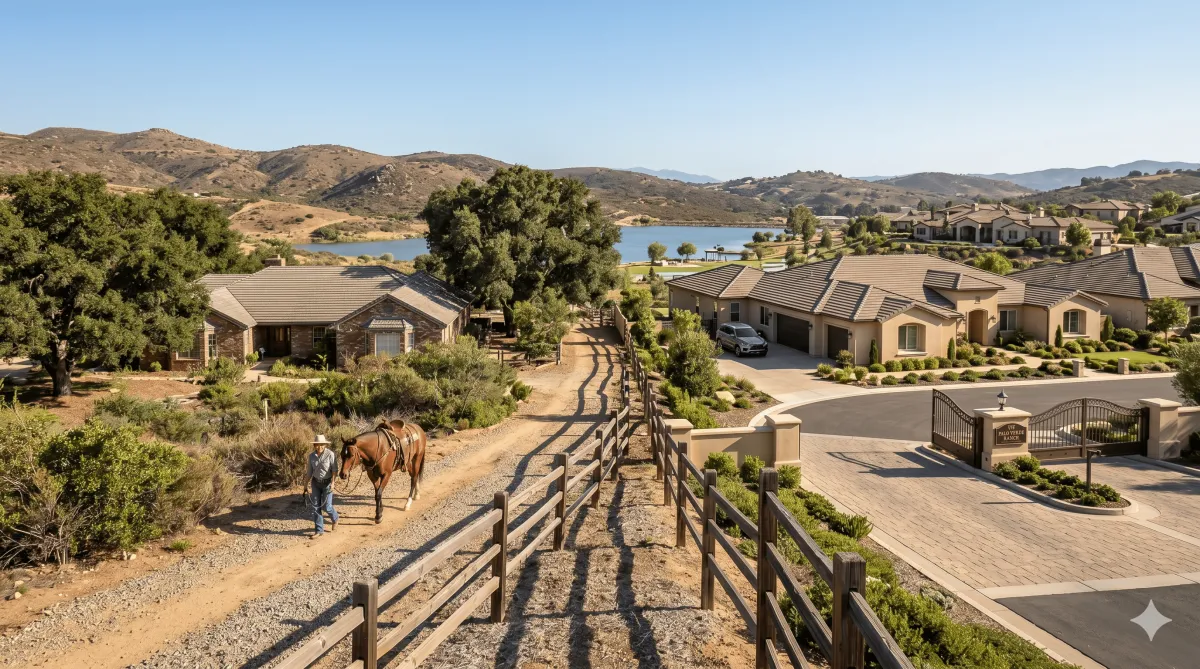
The short version: Old Ranch leans rustic, varied, and laid-back, with lower HOA dues and more character. New Ranch leans gated, polished, and upscale, with higher dues and a more uniform luxury feel. Neither is objectively better. The right fit depends on the lifestyle you actually want, not which sounds more impressive on paper.
I'll walk you through what each side really feels like, where the practical differences show up, and the mistakes I see buyers make when they don't take the comparison seriously.
What Both Sides Share
Before getting into the differences, it helps to anchor on the parts that don't change.
Both Old Ranch and New Ranch share Palo Verde Lake and Little Lake, clubhouse access, and the community-focused atmosphere that makes the broader neighborhood distinctive in East County San Diego. Both are horse-friendly. Both offer larger lots than you'd find in standard Alpine tract neighborhoods, more privacy than the developments closer to Alpine Village, and a foothill setting that feels rural without being remote. The community sits in the same general stretch of East County as the Viejas area and Blossom Valley, but with its own contained identity.
So if you're choosing between the two sections, you're not choosing between two different lifestyles entirely. You're choosing between two flavors of the same one.
The differences are real though, and worth understanding before you start writing offers.
What Old Ranch Actually Feels Like
Old Ranch is the original part of Palo Verde Ranch, and you can feel the history of it as you drive through. The homes don't match. Architecture shifts from one parcel to the next. Some properties look like they've been carefully restored. Others are quietly aging. Lot layouts vary street by street.
That mix is part of the appeal for the buyers who choose it.
The vibe is more rustic and relaxed. Less curb appeal pressure. More homes that look genuinely lived-in rather than staged. A lot of long-term owners who've been there for decades and put their own stamp on their property. Old Ranch is where you're more likely to find acreage with workshops, hobby setups, real horse properties, and the kind of yards that don't fit into a tract neighborhood.
HOA dues here are lower than in the gated section. That matters more than people realize when they're running their monthly budget.
If you value character, variety, lower carrying costs, and the freedom that comes with a more relaxed neighborhood culture, Old Ranch tends to be the better fit.
What New Ranch Actually Feels Like
New Ranch sits behind a gate, and you notice the difference within a few minutes of being inside.
The homes in New Ranch tend to be larger on average, more consistent in quality, and lean toward custom and estate-style construction. Curb appeal is more uniform. Landscaping is more deliberate. The streets feel quieter in a slightly more controlled way, partly because of the gate and partly because the homes were built with privacy and presence in mind.
This is the section that reads as a true gated community in Alpine. Buyers coming from more upscale parts of San Diego County often feel more at home here on the first drive-through, simply because the visual language is familiar.
HOA dues in New Ranch are noticeably higher. Those dues go toward maintaining the gated infrastructure and the more polished common areas. If you're buying in this section, that monthly cost is part of the lifestyle you're paying for.
If you want gated privacy, newer or higher-end homes, and a more uniform upscale atmosphere, New Ranch is usually the right side of the community for you.
HOA Differences: More Than Just Dollars
The dues conversation gets oversimplified.
Yes, New Ranch dues are higher than Old Ranch dues. That's the surface answer. But the real differences go deeper.
The gated infrastructure changes the daily rhythm of the neighborhood. Access control, more deliberate common-area maintenance, and a more managed feel come with it. Old Ranch is more open in character, which some buyers love and others miss when they leave it.
HOA rules differ in tone too. New Ranch tends to carry more expectations around exterior consistency. Old Ranch is generally more flexible on what your property looks like and what you can do with it. Neither approach is wrong. They just appeal to different personalities.
Before committing to either side, read both sets of HOA documents carefully. Pay attention to architectural rules, animal allowances, vehicle and RV storage policies, and maintenance expectations. Those details shape daily life more than the monthly dollar figure suggests.
Price and Value Are Two Different Conversations
New Ranch homes generally sell at higher price points than Old Ranch homes. The construction is often newer, the lots are configured for larger custom builds, and the gated component adds to overall positioning.
That doesn't make Old Ranch the "value" side and New Ranch the "premium" side. It's more nuanced than that.
A well-updated Old Ranch home on a flat, usable, view-facing parcel can be one of the strongest properties in all of Palo Verde Ranch. A New Ranch home on a hillside lot with limited usable land might not deliver the value its asking price implies. Price per square foot doesn't tell you much in this community. Lot usability, condition, view, updates, and overall fit drive value more than the section a home sits in.
When buyers focus only on the price spread between the two areas, they miss those distinctions.
Which Side Tends to Fit Which Buyer
After working with a lot of buyers moving to Palo Verde Ranch, certain patterns repeat.
Buyers who tend to prefer Old Ranch:
Horse owners who want functional acreage and flexibility
Buyers who value rural character over polish
People relocating from less manicured neighborhoods
Buyers prioritizing lower monthly carrying costs
Anyone comfortable with a home that may need updates over time
Buyers who tend to prefer New Ranch:
Buyers coming from upscale coastal or inland communities who want familiar visual cues
People who want a turnkey home with current finishes
Anyone who prioritizes gated privacy and a more controlled neighborhood feel
Buyers comfortable with higher HOA dues for the gated lifestyle
Those who want consistency throughout the neighborhood
There's no rule though. I've seen buyers who looked perfect for New Ranch on paper fall in love with an Old Ranch property because of the land, the views, or the feel of a particular street. The fit is personal.
One example worth sharing: we had clients arrive assuming they wanted New Ranch because they were coming from a gated community closer to the coast. After spending an afternoon walking properties in both sections, they ended up writing an offer on an Old Ranch home. The lot usability, the privacy from how the parcel was situated, and the lower monthly dues changed their thinking. The opposite happens too. Buyers expecting to want Old Ranch character sometimes realize they actually prefer the New Ranch atmosphere once they're inside it.
That's why walking both sides matters before locking in a preference.
Buyers comparing Palo Verde Ranch often end up comparing it with other East County communities like Blossom Valley, or with larger-lot properties throughout Alpine that sit outside any HOA. That broader comparison is worth doing too, especially if HOA culture or gated infrastructure is a major factor in your decision.
What Buyers Tend to Overlook
A few things consistently catch buyers off-guard when they're comparing the two sections.
Insurance can vary property to property, regardless of which side you're on. Foothill location, vegetation density, distance to fire response, and the age of the home all factor in. East County wildfire considerations matter on both sides of the community, and you'll want to start that conversation early in your home search.
Septic systems are common in both sections. Inspections should be part of your due diligence either way.
Usable land matters more than total acreage. Some New Ranch lots are larger on paper but mostly hillside. Some Old Ranch lots are smaller but almost entirely flat and functional. That difference shapes how you actually live on the property.
Maintenance expectations are bigger than most buyers anticipate, especially on acreage homes. Both sections require brush clearance, defensible space management, and ongoing attention to outbuildings and fencing. That's part of the rural Alpine lifestyle.
Commute realities apply to both sides equally. South Grade Road and Tavern Road are your primary connections down to Interstate 8. Plan for 20 to 25 minutes to El Cajon and 35 to 45 minutes to downtown San Diego depending on time of day.
Common Mistakes Buyers Make
The mistakes that come up most often when buyers are comparing Old Ranch and New Ranch:
Assuming both sides feel the same because they share a name and amenities.
Focusing on square footage and HOA dollars while ignoring lifestyle fit.
Underestimating how different the daily experience can feel between a gated section and an open one.
Falling for views without checking the usability of the land beneath the view.
Picking the section that sounds better instead of the one that lives better.
None of these are catastrophic. They just lead to buyer's remorse, and they're avoidable when you slow down and actually compare the two sections in person.
Frequently Asked Questions
Is New Ranch gated? Yes. New Ranch is the gated section of Palo Verde Ranch. Old Ranch is not gated.
Which section has higher HOA dues? New Ranch has higher dues, largely because of the gated infrastructure and more uniform common-area maintenance.
Are homes in Old Ranch older? On average, yes. Old Ranch is the original part of the community, so you'll find a wider range of construction ages, including original homes and homes that have been updated over the years.
Which section is more expensive? New Ranch homes generally sell at higher price points, but individual property value depends heavily on lot, condition, views, and updates rather than which section a home is in.
Which area has larger lots? Both sections offer larger lots than standard Alpine neighborhoods. Lot size varies within each section, and usable land matters more than total acreage.
Are both sections horse-friendly? Yes. Horse-friendly properties exist in both Old Ranch and New Ranch, though setups and configurations vary.
Is Palo Verde Ranch a good place to live? For buyers who want a rural Alpine lifestyle, larger lots, community amenities, and a sense of neighborhood identity, Palo Verde Ranch is one of the stronger choices in East County San Diego.
Which section feels more rural? Old Ranch generally has a more traditional rural feel because of its open character and variety in homes. New Ranch feels more like a gated estate community within a rural setting.
Does Palo Verde Ranch have private lakes? Yes. Palo Verde Lake and Little Lake are private community amenities accessible to residents of both Old Ranch and New Ranch, along with the shared clubhouse.
Is Palo Verde Ranch considered luxury real estate in Alpine? Parts of it, yes. New Ranch in particular includes a number of larger custom and estate-style homes that fall into the higher end of the Alpine market. Old Ranch covers a wider price range and includes both modest and upgraded properties.
Final Thoughts
Neither Old Ranch nor New Ranch is objectively the better section. They're different expressions of the same broader community, and the right fit depends on what you actually want out of daily life.
If you want character, variety, a more relaxed neighborhood culture, and lower monthly carrying costs, Old Ranch tends to suit you better. If you want a gated community in Alpine with newer, more uniform, higher-end homes and don't mind the higher HOA dues, New Ranch usually fits better.
The strongest move you can make as a buyer is to physically walk both sections before deciding. Drive through Old Ranch on a slow weekday morning. Drive into New Ranch and pay attention to the shift in feel as the gate closes behind you. Talk to neighbors when you can. Notice which one settles you and which one keeps you slightly on edge.
That gut response usually tells you more than any spreadsheet comparison.
Jacob Menath is a real estate agent in Alpine, CA serving San Diego County, helping homeowners make informed, confident decisions when selling their home and navigating major life transitions.
Menath Real Estate Team | Alpine, CA | Serving San Diego County