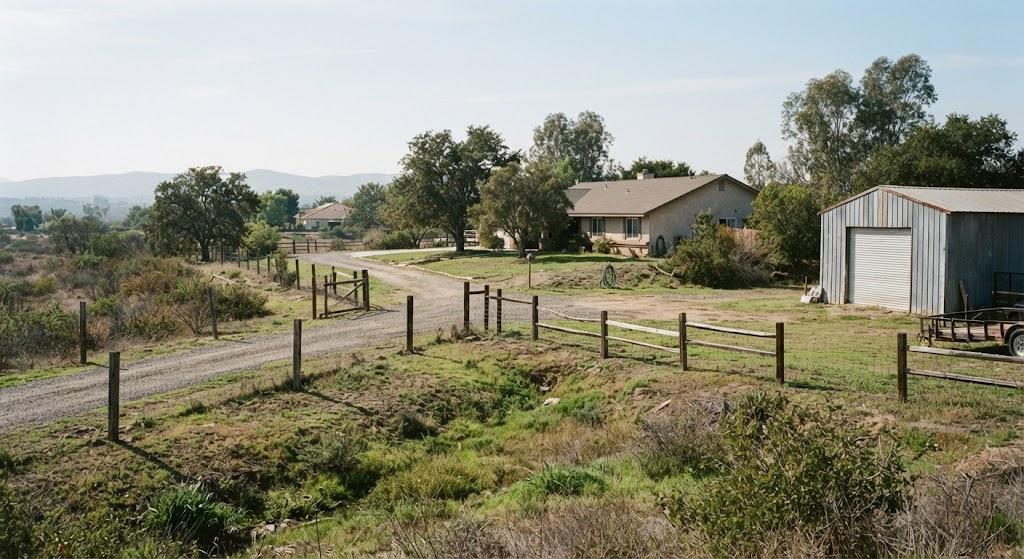
What to Watch for When Buying a Rural East County Home
A rural property can look incredible online.
A few acres. A workshop. Views that go on for miles. Enough space, finally, for something you've wanted for years.
But when I'm walking rural properties with buyers in East County, I'm rarely looking only at the house.
I'm looking at everything around it.
How do you get to the property? Where does the water come from? What's happening with the land itself? What are those extra structures out back? Who's actually responsible for maintaining that road you just drove in on? And what does insurance look like once you own it?
I'm Jacob Menath, a real estate agent with Menath Real Estate Team in Alpine, California, helping buyers and sellers throughout Alpine and East County San Diego navigate major lifestyle transitions.
Here's something I've learned working around rural and semi-rural property for a long time:
The house may be the most obvious thing you're buying. It isn't always the most complicated thing you're buying.
The short answer
When you're buying a rural home in East County, don't stop your investigation at the front door.
Depending on the property, I'd want to understand:
Water and septic
Roads and access
Acreage, terrain, and drainage
Outbuildings and improvements
Wildfire and insurance
Utilities and internet
Boundaries and easements
Ongoing maintenance
None of that automatically means something's wrong with the property.
It just means rural property has more moving parts than a conventional subdivision home, and assumptions get more expensive when there are more moving parts to be wrong about.
Don't treat septic like sewer
A lot of rural East County homes run on septic instead of a municipal sewer connection. If you're coming from a suburban neighborhood, this can feel unfamiliar, and that's okay.
A septic system isn't a reason to walk away from a property. But I wouldn't buy one while assuming it works exactly like the sewer hookup at your last house. Every system is different, and the records, condition, and history behind it matter.
Find out what's actually serving the home. Get the right property-specific evaluation. Different infrastructure calls for different questions.
Understand where the water actually comes from
Some East County properties are on a public water provider. Others rely on a private well. You can't generalize across the area, even between two homes a mile apart.
One of the first questions worth asking is simple: where does this property get its water?
If there's a well, you'll want to understand the specific system, whatever records exist, and consider the appropriate property-specific testing or professional evaluation. And if you have a particular plan for the land, whether that's animals, a garden, or something else, don't assume the well automatically supports it. That intended use needs its own independent verification. A working well and a well that supports your plans are two different questions.
"It has water" and "I understand this property's water situation" aren't the same statement.
Private and shared roads deserve a closer look
The road leading to a rural home often looks like nothing more than a long driveway. Sometimes that's exactly what it is.
But if the road is private or shared with neighboring properties, there are usually additional questions worth asking. Who uses it? How is maintenance actually handled, and by whom? Are there any agreements in writing? What kind of condition is it in right now, and what would it take to keep it that way?
I've seen buyers assume that whoever's driving on the road is the one responsible for taking care of it. That's not always true, and it's worth confirming rather than guessing.
The physical condition of the road and the responsibility for maintaining it are two separate questions.
Access and easements can be easy to miss during a showing
This is one of the deeper issues that doesn't always surface on a first walkthrough.
Rural properties sometimes involve access arrangements that aren't obvious just by looking at the land. A road might cross a neighboring parcel. Someone else might have rights to use part of your property. Utility lines might cross sections of the land in ways you wouldn't notice unless you were looking for them.
If access or an easement matters to how you intend to use the property, this isn't something to interpret casually on your own. Look at the relevant documents, and get appropriate professional guidance if anything is unclear.
Physical access and legal access aren't the same question, and it's worth not confusing them.
Acreage doesn't tell you how much land you'll actually use
This one comes up constantly, and it's probably the single biggest misunderstanding I see.
Five acres sounds like five acres. But two five-acre properties can create completely different ownership experiences.
One might have a layout, slope, and access that make most of the land genuinely usable for what you have in mind. Another might look similar on paper but have significant slope, difficult access, drainage characteristics, or a configuration that makes portions of the property less practical for that buyer's intended use.
More land doesn't automatically mean more usable land. It just means more land.
Pay attention to drainage and terrain
This deserves its own conversation, separate from acreage in general.
A beautiful hillside or a low, flat area can look completely different depending on the season and the weather. What feels like a gently sloped lawn in August might behave very differently during a wet winter.
Look at the terrain with that in mind. Ask what happens when it rains. If slope, drainage, retaining features, or erosion matter to your decision, that's worth investigating specifically rather than assuming based on a single dry-day showing.
A property tour on a clear afternoon doesn't necessarily tell you how water moves across that land the rest of the year.
Outbuildings can add appeal, and they can add questions
Workshops, barns, extra garages, sheds, converted spaces, ADUs. These are often exactly what draws buyers to a rural listing in the first place.
A workshop might be the reason you clicked on the listing. But before assigning value to it in your head, it's worth understanding what you're actually buying. What is the structure, specifically? What condition is it in? What records exist for it? And if you have a specific use in mind, have you actually confirmed that use is possible?
Don't pay for an assumption about a structure you haven't verified.
Don't assume every improvement was permitted
Rural properties tend to accumulate changes over the years. Previous owners add structures, enclose porches, convert garages, or modify the property in ways that made sense to them at the time.
That history doesn't automatically tell you whether something is fine or a problem. It just tells you it's worth looking into.
If a particular improvement matters to why you want the property, or affects what you're willing to pay for it, take the time to understand the available permit information and get the right guidance where it's needed.
Wildfire and insurance need to be evaluated property by property
This is a big one in this part of San Diego County, and it's an area where I see a lot of assumptions get made too quickly.
Wildfire preparedness is a real part of rural ownership in portions of East County. But not every rural property carries the same exposure, and not every property has the same insurance options available to it.
Vegetation, surroundings, access, and defensible space all factor in, and they vary a lot from one parcel to the next, even within the same general area. Get property-specific insurance information from an insurance professional early in the process, not after you're already in escrow.
Don't evaluate rural property insurance based on the ZIP code. Evaluate the actual property you're buying.
Verify utilities and internet at the actual address
Rural properties are less standardized than a suburban subdivision where every home was built the same way at the same time.
If reliable internet matters to you, and for a lot of buyers working from home these days, it does, verify it at the specific address, not just the general area. If the home uses propane, understand the system and what ownership involves rather than treating it like conventional natural-gas service.
Just because a utility or service exists somewhere nearby doesn't mean this particular property is connected to it, or connected in the way you're picturing. "Available in the area" and "available at this house" are two different answers, and it's worth getting the second one before you're in contract.
Know what you'll actually be responsible for maintaining
Rural ownership gives you more control over your surroundings. It also gives you more surroundings to take care of. That's the tradeoff, and it's a real one.
Acreage, vegetation, brush clearance, fencing, trees, private roads, drainage, outbuildings, long driveways. Some buyers genuinely love having land and projects to manage. Others discover, a season or two in, that the privacy they wanted also came with a weekend maintenance schedule they didn't fully sign up for.
It's worth being honest with yourself about which kind of buyer you are before the acreage becomes your Saturday.
Fences don't necessarily answer the boundary question
A fence feels like an obvious property line. It isn't always.
If the exact boundary matters to how you plan to use the property, whether that's for a fence project of your own, an addition, or just knowing exactly what you own, it's worth understanding what documentation is actually available and whether additional professional investigation makes sense.
A fence tells you where someone put a fence. It doesn't necessarily establish the property's actual boundary.
Know what you're actually buying on the ground
Buyers often walk a rural property and mentally assign areas of it to themselves. That flat stretch becomes the future garden. That tree line becomes the property edge. That open area becomes space for animals or a shop.
None of that is unreasonable. It's just visual, not verified.
If a particular part of the land is important to why you're buying the property, don't rely on visual assumptions alone. This connects directly back to acreage, fencing, and easements. What you see when you're standing on the property and what the documentation actually shows can be two different things, and it's worth knowing which one you're relying on before you make an offer.
Unique rural homes can be harder to compare
Rural East County properties often have combinations you won't find in a typical subdivision. Acreage, views, a workshop, a custom-built home, unusual outbuildings, a different kind of access than the house down the street.
That mix can make straightforward comparisons more difficult when it comes to understanding value. It doesn't automatically mean the property is worth more or less than a similar-looking listing elsewhere. It means the valuation may require more context than simply comparing it with a handful of loosely similar nearby sales.
Don't let the lifestyle distract you from the property
Rural properties are easy to romanticize, and honestly, I understand why.
You stand outside on a quiet piece of land. You look at the view. You picture the garden, the workshop, the animals, the RV, the projects you've been wanting for years.
That's a fine thing to feel. Just try to separate the dream from the due diligence.
Ask yourself whether the property actually supports the life you're imagining. And ask whether you genuinely want the responsibilities that come attached to it, not just the parts you've been picturing.
Don't buy rural property because you love the idea of rural living. Buy it because you understand the specific property in front of you, and you genuinely want the life that comes with owning it.
A pattern I see with buyers
Buyers usually arrive at a rural property looking at what they can see. The house. The view. The workshop. The open land.
Then the questions start.
Where does the water come from? What's the situation with that road? How much of this acreage is actually usable? What is that structure out back? What will insurance look like? Who's responsible for keeping this maintained?
Somewhere in that process, the conversation shifts from "do I love this property?" to "do I understand this property?"
That's the shift I try to help buyers get to. Because you can genuinely love a rural property and still decide it isn't right for you once you understand it fully. And you can start out a little intimidated by a rural property, take the time to understand it properly, and decide the extra responsibilities are completely worth it.
Questions worth asking yourself
Where does the water come from?
Is there septic?
Is access public, private, or shared?
How is road maintenance actually handled?
Are there easements relevant to what I want to do with the property?
How much of the acreage is genuinely usable?
What's the terrain and drainage like?
What additional structures exist, and what records are available for them?
Have I confirmed any specific use that matters to me?
What does insurance realistically look like here?
What utilities and internet actually serve this address?
What will I be responsible for maintaining?
Do the fences match what I understand about the boundaries?
How does this property compare to what else has sold nearby?
The bigger question underneath all of it: what am I assuming about this property that I haven't actually verified yet?
Frequently asked questions
What should I inspect when buying a rural home in East County? It depends on the specific property. Beyond the home itself, buyers often need to look into septic, water source, private roads, access, outbuildings, drainage, utilities, insurance, and other property-specific features.
Are rural homes harder to buy than suburban homes? Not necessarily harder, just different. They tend to involve more property-specific questions, because the land, infrastructure, access, and additional improvements play a bigger role in the purchase.
Should I worry about septic when buying a rural home? A septic system isn't automatically a problem. What matters is understanding the specific system on that property and getting the appropriate evaluation, rather than assuming it behaves like municipal sewer.
What should I know about buying a home with a well? Start by understanding the property's water source and the specific well system serving it. Review whatever records are available and get the testing or professional evaluation appropriate for your purchase.
Are private roads a problem when buying a home? Not automatically. The important questions are about access, condition, maintenance responsibility, and any agreements tied to that specific road.
Does acreage increase a home's value? Not automatically. Land is often valued based on usability, access, terrain, location, improvements, and privacy, not acreage alone. More land doesn't necessarily mean proportionally more value.
Is rural East County property difficult to maintain? It depends heavily on the specific property. Larger parcels can involve vegetation, roads, drainage, fencing, trees, and outbuildings that a conventional suburban home simply doesn't have.
What is the biggest mistake buyers make with rural property? One of the biggest mistakes is assuming a rural property works like a conventional suburban home. Depending on the property, the land, water source, septic system, roads, access, outbuildings, utilities, insurance, and maintenance responsibilities may all deserve separate investigation.
The bottom line
So, what issues should you watch for when buying a home in rural East County?
Watch for assumptions.
Don't assume acreage is usable. Don't assume a fence marks the boundary. Don't assume a private road tells you who maintains it. Don't assume a workshop supports whatever you have planned for it. Don't assume the water source works the way you're picturing. Don't assume internet is available just because the listing says so. Don't assume insurance will look anything like it did on your last house.
Investigate the property you're actually buying.
The house matters. But so do the land, the access, the water, the infrastructure, the improvements, the insurance, and the responsibilities that come along with all of it.
The goal here isn't to make rural property sound complicated. It's to make sure you actually understand it before you own it.
Jacob Menath is a real estate agent with Menath Real Estate Team in Alpine, California, helping buyers and sellers throughout Alpine and East County San Diego navigate major lifestyle transitions.
Menath Real Estate Team | Alpine, CA | Serving San Diego County



