What to Know Before Buying Land in Alpine, CA
By: Jacob Menath
Buying land in Alpine can look pretty straightforward.
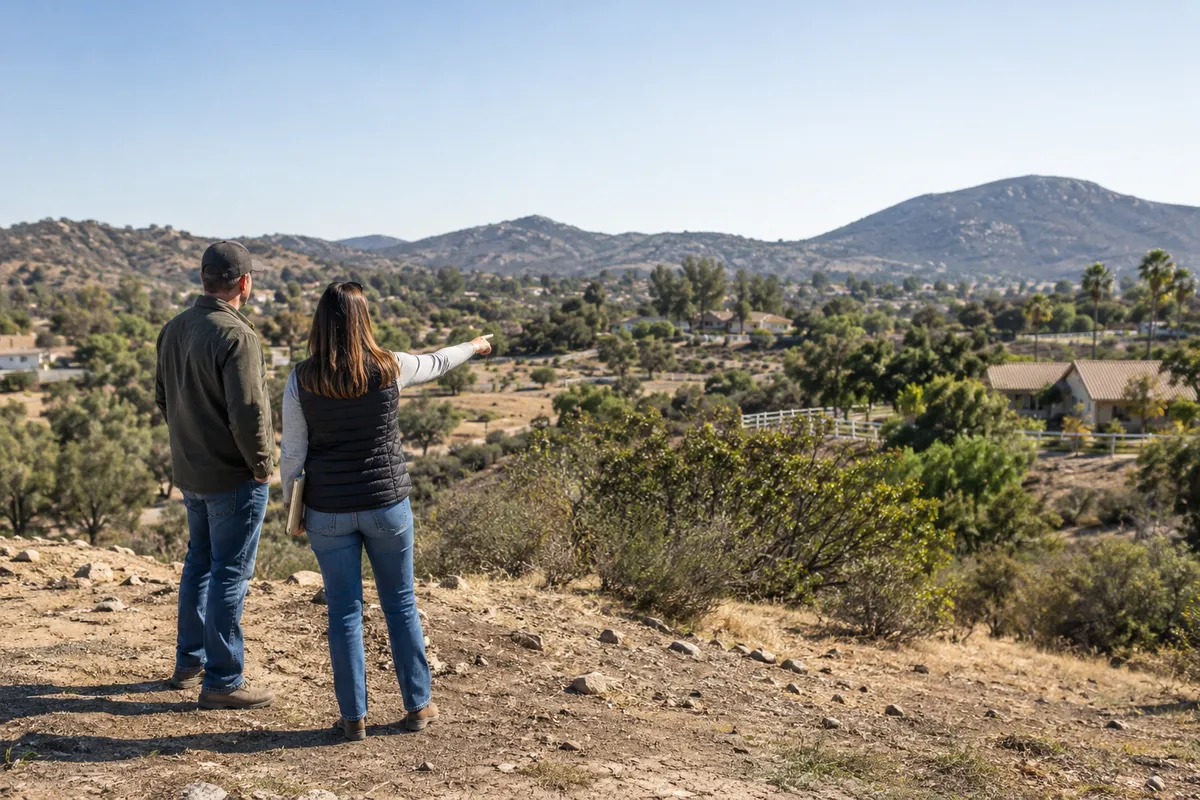
You find a few acres. The views are great. Maybe there's already a driveway cut into the property. And before long, you're standing there imagining the house, the workshop, the horses, the RV parking, or whatever extra space you've been wanting.
That's usually when I'd slow the conversation down.
I'm Jacob Menath, a real estate agent with Menath Real Estate Team in Alpine, California, helping buyers and sellers throughout Alpine and East County San Diego navigate major lifestyle transitions. When you're buying an existing house, you can inspect what's already there. With vacant land, you're often buying based partly on what you hope to put there later. That's a different kind of homework.
So instead of just asking "do I like this piece of land," I'd ask a second question right alongside it: what would have to be true about this specific parcel for my plan to actually work?
The short answer
Before buying land in Alpine, you want to understand the specific parcel, not just its acreage and asking price.
Depending on what you're planning to do with it, that can mean looking into zoning, permitted uses, topography, how much of the acreage is actually usable, legal and physical access, easements, water, septic feasibility, utilities, drainage, wildfire considerations, insurance, boundaries, development requirements, financing, and what it might realistically cost to turn vacant land into the property you actually want.
A parcel can look inexpensive next to a finished home. That doesn't automatically mean your finished project will be inexpensive too.
The purchase price tells you what the land costs to buy. It doesn't tell you what the land may cost to use.
With vacant land, you're evaluating both the parcel you can see today and the feasibility of what you hope to create there later.
Start with what you actually want to do with it
Before you look at zoning maps or utility lines, get clear on your plan first.
Are you trying to build a primary residence? Build later and just hold the land for now? Keep horses? Add a workshop? Store an RV or equipment? Create space for extended family, or eventually build an ADU? Something else entirely?
Those aren't interchangeable goals. A parcel that works beautifully for one buyer's plan can be completely wrong for another buyer's plan, even if the two parcels sit right next to each other.
Don't start with "what can I buy." Start with "what am I trying to create." Then go find out whether the land in front of you actually supports it.
Zoning is one of the first things to understand
A vacant parcel gives you plenty of room to imagine what's possible. The zoning tells you something more useful: what rules actually apply to that property.
San Diego County's zoning system can involve the parcel's use regulations, development regulations, animal designator, and other property-specific requirements. If your purchase depends on being able to do something particular with the land, don't rely on the listing description, and don't rely on what appears to be happening on the parcel next door.
What somebody did on the neighboring lot doesn't automatically tell you what you can do on yours.
For a specific development plan, I'd always point buyers toward verifying current requirements directly with San Diego County Planning & Development Services, along with the appropriate professionals for their situation.
San Diego County also provides property and zoning tools that can help you identify the regulations associated with a particular parcel. That's a useful starting point, but if your purchase depends on a specific development or use, confirm the current requirements directly with the County and the appropriate professionals before you rely on it.
"Can I build on it?" is a bigger question than it sounds
This is usually the first question buyers ask about vacant land, and it's the right one. It just tends to open up several more.
The fact that a parcel exists doesn't, by itself, tell you exactly what can be built, where it can be built, or what it would take to get there. Depending on your plan, that can mean looking into zoning, setbacks, access, grading, water, wastewater, utilities, site conditions, and other development requirements.
Vacant land and a ready-to-build homesite aren't the same thing. I wouldn't call a parcel buildable simply because a listing says so. Treat "buildable" as a claim to investigate, not a conclusion to rely on.
Acreage doesn't tell you how much land you can actually use
Five acres sounds like five acres. On paper, it is.
But once you start thinking about building, horses, a workshop, parking, or any other future use, total acreage stops being the only number that matters. What you also want to look at is the slope, the parcel's configuration, existing access and roads, drainage features, terrain, where improvements could realistically go, and any other constraints tied to what you're planning.
More land doesn't automatically mean more usable land. It just means more land.
This can be especially easy to underestimate when you're used to more conventional suburban lots. A five-acre lot in a subdivision and five acres in the Alpine foothills can behave very differently once you actually try to use them.
(Internal link: Can You Buy Horse Property in Alpine, CA?)
Topography can change the entire conversation
A relatively flat parcel and a steep hillside parcel can both be five acres on paper. They aren't necessarily the same development project.
If your plan involves building, grading, driveways, retaining features, septic, or other site work, terrain can end up being a major part of the conversation, sometimes bigger than the buyer expected going in.
Don't evaluate land only from the road. Walk it when you can. Look at how the property changes in elevation, and think honestly about where you're picturing the improvements going. Then have the right professionals look at whether that vision is actually feasible and what it may involve.
The view may be what makes you fall in love with the land. The terrain is often what determines what it takes to use it.
Make sure you understand access
Seeing a dirt road leading toward a parcel doesn't necessarily answer every access question you need answered.
When access matters to your plan, there are really two things to understand. There's physical access: how do you actually get onto the property? And there's legal access: what rights exist to use the route that gets you there? There may also be questions involving easements, private or shared roads, gates, or who's responsible for maintaining them.
A road on the ground and a legal right to use that road aren't automatically the same thing.
It's also worth asking whether the access that exists today would work for construction, emergency, utility, or everyday access under your plan. Buyers often think only about whether their own car can get there, which is a different question from whether the site can practically support the project they have in mind.
If access is important to your purchase, I'd rather see it confirmed through the appropriate title and recorded-document review, along with the right professionals, than assumed from how things look during a showing.
Water can be a deal-defining question
Don't look at a vacant parcel and assume water will be simple just because the homes nearby have it.
The real question is what the realistic water situation looks like for this specific parcel and your intended use. Depending on the property, that may mean investigating an available public service connection or another water source entirely. And if your plans involve a home, horses, landscaping, or anything else that depends on water, that conversation should start early, not after you're already in escrow.
"There's water nearby" and "I understand how this parcel will get water" are two different statements, and buyers sometimes treat them as the same one.
Septic feasibility can matter before there's ever a house
If the property isn't served by sewer and your plan involves building a home, wastewater isn't something to leave until the end of the process.
A vacant parcel may need its own property-specific investigation to determine what septic solution, if any, is feasible, and what requirements would apply. This isn't an area where I'd want a buyer leaning on "the neighboring house has septic, so this should be fine."
A neighboring property's septic system tells you about the neighboring property. Your parcel still needs its own answers.
Utilities can be nearby without being easy to connect
Power lines visible from the road don't automatically tell you what it will take to establish service to your specific parcel. The same idea applies to water, internet, and other communications.
For your parcel, it's worth investigating electricity, water, internet, communications, and anything else that matters to your plans, and being clear about the difference between "available in the area" and "available to this parcel, on terms that actually work for your project."
Available nearby isn't the same as ready at the property.
Drainage and site conditions matter
Vacant land can look very different depending on when you happen to visit it.
A dry Alpine afternoon may not tell you much about how water moves across a parcel once the weather changes. It's worth paying attention to visible drainage features, slope, erosion, low spots, and anything else that raises a question in your mind. If it matters to your project, have the right professional take a closer look.
A dry-day showing doesn't tell you everything about how the land behaves once conditions change.
Wildfire considerations don't start after you build
If you're considering land in Alpine, wildfire and insurance belong in the conversation before there's a finished house on the property, not after.
Your plans may raise questions about access, vegetation, defensible space, construction requirements, and future insurability. I'm not the person who assigns wildfire risk or determines whether a future home will be insurable. Those are questions to work through with the appropriate agencies, professionals, and insurance providers, based on the actual parcel and the project you're proposing.
Don't wait until the house exists to start thinking seriously about what it means to own property here. With vacant land, some of those questions can affect the development plan itself, not just what happens after the home is built.
Know where the property actually begins and ends
Vacant land can be surprisingly easy to misjudge when the boundaries aren't obvious.
A fence, a dirt road, a tree line, or the way a neighbor is using their land doesn't necessarily tell you where the legal property line actually sits. If a boundary matters to what you're planning, don't rely solely on what looks obvious during a showing.
The land you're picturing yourself using needs to actually be the land you're buying.
Financing vacant land is different from financing a house
Don't assume the mortgage structure you'd use to buy an existing house will work the same way for vacant land.
Land financing and construction financing can come with different lender requirements, down-payment requirements, timelines, and underwriting considerations, and those can vary quite a bit from one lender or loan product to the next. This is lender territory, not something I'd want to guess at. If financing is part of your plan, talk with a lender who actually handles the type of land or construction financing you're considering, and do it before you build your search around a specific price point.
Understand how you're going to finance the land before you fall in love with land you can't finance the way you expected.
The cheapest parcel isn't necessarily the cheapest project
This might be the most important thing to sit with before you make an offer.
A vacant parcel can look inexpensive next to an existing Alpine home. But the land purchase may only be the first expense on the list. Depending on your project, there can eventually be costs tied to design and engineering, permits, site preparation, grading, access, water, septic, utilities, construction, drainage, and other property-specific work.
I'm not suggesting every parcel needs every one of those things. The point is simpler than that: land price and finished-project cost are two different numbers, and it's worth knowing roughly what the second one might look like before you commit to the first.
A cheap piece of land can become an expensive place to build.
There's another cost that's easy to underestimate: time. Investigating a parcel, designing a project, obtaining approvals, preparing the site, establishing utilities, and eventually building can create a very different timeline from buying an existing home.
If your life requires you to be living somewhere six months from now, the development timeline matters just as much as the purchase price.
Don't pay for someone else's unverified plans
Sometimes vacant land gets marketed with language like "perfect building site," "ready for your dream home," "great ADU potential," "horse property," or "utilities nearby."
Those descriptions can be useful starting points. They aren't a substitute for verification.
Don't assign value to a future use until you've actually investigated whether that future use works on this parcel, for your plan, under current requirements.
Think about the exit before you buy
Even if your plan is to hold the property for years, it's worth asking what happens if your plans change.
Maybe construction turns out more expensive than expected. Maybe your timeline shifts. Maybe you decide you don't want to build after all, or life simply takes you somewhere else. Land can be a more specialized purchase than a conventional home, so it's worth thinking early about who a future buyer might be and what questions they'd ask about the same parcel.
You're buying today's land and tomorrow's resale question at the same time, whether that turns out to be a problem or an opportunity.
A common pattern with land buyers
A buyer finds a parcel with a beautiful view and starts mentally designing the house before we've even answered the basic property questions. That's understandable. Vacant land makes it easy to picture possibilities, because there's nothing already built there to limit your imagination.
But at some point the conversation has to shift from "what could I put here" to "what have we actually verified that I can do here." Those are genuinely different questions, and the second one is the one that protects you.
With vacant land, possibility is exciting. Verification is what makes possibility useful.
Questions worth asking yourself
What exactly do I want to do with this land?
What zoning applies to this parcel?
Does my intended use appear compatible with those rules?
What additional County requirements could affect my plan?
How much of the acreage is practically usable for what I want?
What is the terrain like?
Do I understand both physical and legal access?
Are there easements that matter to my plans?
Who maintains any private or shared access?
Where will the water come from?
What is the wastewater or septic situation?
What utilities are actually available to this parcel, not just the area?
What do I know about drainage and site conditions?
Have I looked into wildfire-related considerations?
What might insurance look like after development?
Do I understand the property's actual boundaries?
How am I financing the land?
How would I finance construction later?
What costs exist between buying the dirt and having the finished property I want?
What happens if my development plan changes?
What part of my plan is absolutely non-negotiable, and have I specifically verified that piece?
What professionals would need to evaluate this parcel before I'd feel comfortable moving forward?
What is my realistic timeline between buying the land and actually using it the way I intend?
The big question underneath all of them: what am I assuming I can do with this land that I haven't actually verified yet?
Frequently asked questions
Can you buy vacant land in Alpine, CA? Yes. Vacant parcels are available in Alpine and the surrounding East County areas. The important question is whether a specific parcel fits your intended use, financing, and development plan.
Can I build a house on vacant land in Alpine? Potentially, but don't assume every vacant parcel is automatically ready for residential construction. Zoning, access, water, wastewater, topography, development requirements, and other property-specific factors may need to be investigated before you know whether your particular plan is feasible.
Is it cheaper to buy land and build in Alpine? Not necessarily. A lower land purchase price doesn't tell you the total cost of creating a finished home. Site work, access, utilities, water, wastewater, permitting, design, construction, and other project-specific expenses can substantially change the equation.
How do I know the zoning of land in Alpine? San Diego County provides parcel-specific zoning information through Planning & Development Services and its property and zoning tools. If your purchase depends on a particular use, verify the current requirements for that parcel rather than relying only on the listing.
Can I keep horses on land I buy in Alpine? Potentially. San Diego County's rules for horsekeeping depend on the specific parcel and applicable zoning and animal regulations. Verify your intended use before assuming acreage alone makes a property suitable for horses.
Do I need a well to build on land in Alpine? Not necessarily. Water arrangements vary by parcel. It's worth determining the actual water options for the specific property instead of assuming all Alpine land is served the same way.
Can I get a mortgage on vacant land? Potentially, but vacant land and construction financing can work differently from a conventional home mortgage. Talk with a lender who handles the type of financing you're considering before assuming a particular structure, down payment, or qualification requirement.
How do I know if land is buildable? There isn't one listing field or single characteristic that tells you a parcel is ready to build. Depending on the property and your plans, you may need to investigate zoning, access, water, wastewater, topography, utilities, site conditions, development requirements, and other parcel-specific factors. Treat "buildable" as something to verify for your particular project rather than something to assume from the listing.
What is the biggest mistake when buying vacant land? One of the biggest mistakes is buying based on what you imagine you'll be able to do with the property before verifying the assumptions that make that plan possible. The acreage, view, and price may get your attention, but zoning, access, water, wastewater, usable land, utilities, and development requirements can determine whether the parcel actually works for you.
The bottom line
Buying land in Alpine can give you the chance to create something that's genuinely hard to find in an existing home.
But vacant land also gives you more room to make assumptions.
Don't buy because the view is incredible. Don't buy because the listing says "buildable." Don't buy because a neighboring property already has the house, barn, or setup you're picturing for yourself.
Start with your plan. Then investigate the parcel: zoning, access, usable land, water, wastewater, utilities, terrain, boundaries, development requirements, and financing.
Because the question isn't really "can I buy this land." It's "can this land realistically support what I'm buying it to do."
Jacob Menath is a real estate agent with Menath Real Estate Team in Alpine, California, helping buyers and sellers throughout Alpine and East County San Diego navigate major lifestyle transitions.
Menath Real Estate Team | Alpine, CA | Serving San Diego County



