Why San Diego Real Estate Holds Long-Term Value
Why San Diego Real Estate Has Historically Held Long-Term Value
By Jacob Menath, Real Estate Agent in Alpine, CA | Menath Real Estate Team
A lot of buyers in San Diego eventually ask the same question:
"How are homes still this expensive?"
It's a fair question. Affordability feels difficult, headlines flip between predictions of crashes and booms, and most people have spent the last few years watching prices do things that don't seem to make sense.
But if you step back and look at San Diego over the long run, the story gets a little clearer. Property values in many parts of the county have historically held up reasonably well through recessions, rate spikes, downturns, and major economic shifts. That doesn't mean prices only go up. They don't. Markets here still go through real cycles and real corrections.
What it does mean is that San Diego has a handful of long-term fundamentals that keep shaping demand decade after decade. Once you understand those, it gets easier to think clearly about long-term ownership instead of reacting to whatever the news is saying this week.
Why Has San Diego Real Estate Historically Held Long-Term Value?
San Diego real estate has historically held long-term value because of several overlapping factors:
Limited buildable land
Consistently strong housing demand
Desirable climate and lifestyle
Military and government employment
Biotech and healthcare growth
Coastal geography
Population pressure
Long-term supply constraints
None of these are guarantees about the future. Markets still cycle, and conditions can shift in ways nobody predicts. But the combination of high desirability and constrained supply has historically supported demand here in a way that's worth understanding before you make a long-term ownership decision.
In Simple Terms
San Diego real estate has historically held long-term value because of:
limited buildable land
strong long-term housing demand
desirable climate and lifestyle
military and biotech employment
coastal geography
and long-term supply constraints
That does NOT mean prices only go up.
But it does help explain why San Diego housing has historically behaved differently than many inland markets over long periods of time.
Limited Land Creates Long-Term Supply Pressure
Start with the geography. San Diego can't expand outward the way many inland cities can.
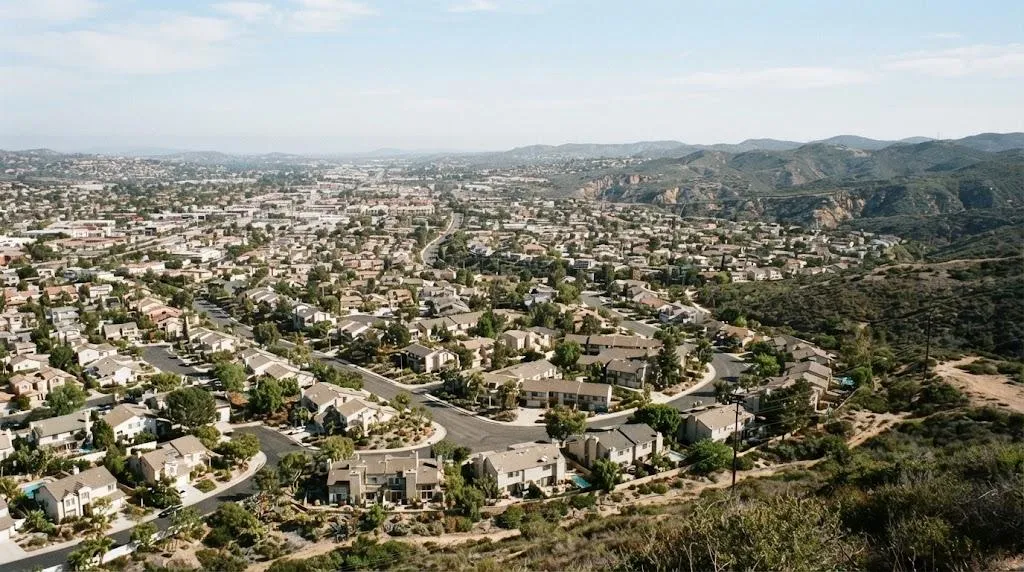
To the west is the Pacific Ocean. To the south is the Mexico border. To the north sits Camp Pendleton, a massive military installation that essentially walls off a huge chunk of coastal land. Inland, you run into mountains, protected open space, tribal lands, and rugged terrain that makes large-scale development difficult and expensive.
Add in slow-moving permitting, zoning constraints, water limitations, and wildfire risk in the foothills, and you end up with a region where building enough new housing to fully match demand has historically been challenging.
Geography Shapes Housing Supply
That doesn't mean nothing gets built. It just means the supply side moves slowly while the demand side keeps showing up.
Physical constraints aren't a marketing story. They're the actual edges of the county.
And they've been there a long time.
Why Demand Has Historically Stayed Strong
A lot of people want to live in San Diego for reasons that go far beyond real estate itself.
The weather stays consistent year-round. The coastline, mountains, and desert are all within an hour or two of each other. There's a strong outdoor culture, mature neighborhoods, and a quality of life that draws people from across the country and around the world.
But it isn't just lifestyle. San Diego's economy is more diversified than people often realize.
San Diego Has Multiple Economic Drivers
The military and defense sectors are large, with Navy, Marine Corps, and Coast Guard installations spread across the county. That base of stable employment has been a fixture for generations.
Biotech and life sciences cluster heavily around Torrey Pines and the surrounding areas. Healthcare systems employ tens of thousands. The university and research ecosystem keeps producing graduates and talent. Tourism brings consistent visitor spending. Cross-border trade with Tijuana adds another layer.
Diversified economies tend to hold up better through downturns than markets that depend heavily on a single industry. When one sector slows, others often keep moving. That has historically been part of why San Diego's housing demand stays relatively durable, even when national headlines turn gloomy.
Why San Diego Housing Often Behaves Differently
San Diego has several long-term fundamentals that historically affect housing demand:
limited land for expansion
strong military presence
biotech and healthcare growth
desirable year-round climate
coastal geography
tourism and higher education
long-term population demand
No market is immune to cycles or corrections. But these fundamentals have historically supported long-term demand over time.
Why Coastal Geography Changes Market Behavior
Highly desirable coastal regions often behave differently than areas with unlimited room to expand.
When inventory is constrained and demand stays steady, prices tend to feel a lot of upward pressure. That's not unique to San Diego. You see similar patterns in coastal markets across California and in places like Seattle, Boston, and parts of Florida.
The frustrating side of this is real. Desirability and affordability often move in opposite directions. The more attractive an area becomes, the harder it can be to buy into. That's the honest part of the conversation, and it's worth saying out loud rather than dressing up.
For buyers, this is part of why thinking long term matters. Trying to perfectly time a coastal market that's been demand-driven for decades is a hard game to win. Choosing something sustainable and giving it time tends to work better than chasing the perfect entry point.
Why Has San Diego Real Estate Stayed Expensive for So Long?
Because the conditions that drive prices haven't really gone away.
Demand has stayed strong across multiple economic cycles. Supply has stayed constrained by geography, regulation, and the practical realities of building in a coastal county. Employment has stayed diversified. The climate hasn't changed. The military isn't leaving. The ocean and the border aren't moving.
That combination has shown up in pricing for a long time. Corrections happen. Cycles happen. But the underlying setup that supports demand has been remarkably persistent.
Why East County Still Matters
As coastal pricing pressures rise, a lot of buyers gradually move east looking for more realistic ownership opportunities.
That's where places like Alpine, Lakeside, Santee, El Cajon, Jamul, and La Mesa come into the picture. East County tends to offer:
Larger lots
More detached single-family homes
ADU potential on the right properties
Semi-rural and acreage options
A different lifestyle pace than the coast
Different parts of San Diego solve different problems. The coast offers walkability, ocean access, and certain lifestyle features. East County often offers more flexibility per dollar, more space, and a quieter rhythm. Neither one is universally better. They just fit different goals.
I've worked with buyers who originally focused entirely on coastal neighborhoods before realizing that areas like Alpine, Lakeside, or Santee offered a much more sustainable ownership path for the lifestyle they actually wanted long term. That shift usually doesn't happen overnight. It happens after a few months of looking, running the numbers, and getting honest about what their day-to-day actually needs to look like.
East County Often Offers More Flexibility Per Dollar
If you're looking at semi-rural or acreage properties out here, there are practical realities to think through, including septic systems, well water, road access, wildfire insurance, and longer commutes. Those tradeoffs are worth understanding before you commit, not after. A property that looks perfect on paper can feel very different once you've driven the road home a few times in winter rain or worked through your first insurance renewal.
Why Buyers Misunderstand Market Cycles
Long-term value does not mean short-term stability.
San Diego has had real corrections. The early 90s recession hit hard. The 2008 housing crash was severe and painful. There have been other slowdowns since. Rates spike, inventory shifts, buyer confidence wavers, affordability gets stretched, and markets cool off.
Every Market Cycle Feels Different
Every market cycle feels unprecedented while you're living through it. Some are driven by rates. Some by national recession. Some by inflation. Some by inventory swings or psychology. The discomfort always looks new, even when the underlying patterns rhyme with what's happened before.
What's been more consistent over long periods of time is that San Diego has tended to recover and continue along. Not in a straight line. Not without pain along the way. The long-term arc has typically been one of enduring demand pressing against limited supply, but past behavior is not a promise about the future.
Why Long-Term Ownership Often Matters More Than Timing
Here's something worth noticing across many conversations with homeowners over the years.
Most of the people who've done well with San Diego real estate didn't time anything brilliantly. They bought a reasonable home they could afford, lived in it, paid down the mortgage gradually, and stayed long enough for time to do the heavy lifting.
That's it.
Most Ownership Progression Happens Quietly
Most real estate success stories are much less dramatic than people think. They tend to look like:
Modest beginnings
Steady ownership
Principal paydown that quietly builds equity
The option to upgrade, downsize, or stay put later
Buyers who chase the perfect moment or stretch beyond what they can sustain tend to have more stressful stories. The ones who chose something sustainable and stayed tend to look back and realize the math worked out.
What Smart Long-Term Buyers Usually Focus On
If you're trying to make a long-term ownership decision in San Diego, the things that tend to matter most are:
Sustainable monthly payments
Long-term affordability, not just qualifying for the loan
Location fundamentals like access, employment, and amenities
Flexibility for future life changes
Realistic timelines for ownership
A property you can actually maintain
Enough reserves to handle surprises
What tends to matter less than people think:
Short-term headlines
Perfect timing
Emotional market predictions
Cosmetic perfection in a home
Hype-driven investing narratives
The unglamorous stuff usually wins. That's not exciting, but it's true.
Common Buyer Misunderstandings About San Diego Real Estate
A few patterns come up again and again:
Assuming prices only go up. They don't. There have been real corrections, and there will be more cycles.
Assuming crashes will permanently reset affordability. They usually don't. Recoveries have historically taken hold over time.
Thinking timing matters more than sustainability. A perfectly timed purchase you can't afford to keep doesn't help anyone.
Ignoring long-term supply constraints. The geography here isn't changing.
Overreacting to headlines. National coverage rarely captures what's actually happening in specific San Diego micro-markets.
Expecting instant equity. Real wealth in housing tends to build slowly.
Comparing San Diego to very different markets. A market like Phoenix or Austin doesn't behave like San Diego, and trying to predict one based on the other usually misleads.
Underestimating the value of simply staying put for a long time.
Why Real Estate Wealth Usually Builds Slowly
A lot of financially comfortable homeowners I've worked with or known over the years made one decision really well: they chose something sustainable, and they gave the math enough time to work.
No flipping. No predicting the top. No refinancing every six months. They bought a home they could keep, made their payments, and let two or three decades pass.
That's the version of this story that doesn't show up on social media. It's quiet. It takes patience. And it's worked out, more often than not, for people in this region.
FAQ
Why is San Diego real estate so expensive?
The short version is constrained land, strong long-term demand, a diversified economy, and a desirable climate all stacking on top of each other for decades. Supply has had a hard time keeping up with demand, and that pressure shows up in prices.
Does San Diego real estate usually hold value over time?
Historically, many parts of San Diego County have shown resilience over long periods, though there have been cycles, downturns, and real corrections along the way. Past performance is not a guarantee about the future.
Why are homes in San Diego historically desirable?
Climate, coastline, mature neighborhoods, diversified employment, the military presence, biotech, healthcare, and a general quality of life that draws people from across the country and abroad.
What keeps housing demand strong in San Diego?
A mix of employment in defense, biotech, healthcare, higher education, and tourism, combined with the lifestyle appeal of the region. It isn't one industry carrying the whole thing.
Is East County becoming more desirable?
As coastal areas continue to feel pricing pressure, a lot of buyers look east toward Alpine, Lakeside, Santee, El Cajon, Jamul, and La Mesa for larger lots, more flexibility per dollar, and a different lifestyle pace.
Does San Diego real estate always appreciate?
No market always appreciates. San Diego has had real corrections, including the early 90s and 2008. The long-term arc here has historically trended upward, but it has never been a straight line, and there are no guarantees about future performance.
Why do long-term homeowners often do better?
They give the math time to work. Gradual appreciation, principal paydown, and patience tend to compound quietly in ways that short-term moves rarely match.
Thinking About Long-Term Ownership in San Diego?
If you're trying to figure out:
whether ownership realistically makes sense for your situation
how to think long term about San Diego housing
what areas might actually fit your goals
or how to make a smarter long-term ownership decision
those are the conversations Jacob and Kristin Menath have with buyers regularly. No pressure, no urgency, no script. Just a clear conversation about what makes sense for you.
About Jacob and Kristin Menath
Jacob and Kristin Menath are real estate professionals based in Alpine, CA serving buyers and homeowners throughout San Diego County, including East County communities like Alpine, Lakeside, Santee, El Cajon, Jamul, and La Mesa.
They work with first-time buyers, move-up buyers, downsizing homeowners, and families making long-term ownership decisions. Their approach focuses on practical guidance, thoughtful strategy, and helping buyers make confident real estate decisions that support their future long term.
Jacob Menath is a real estate agent in Alpine, CA serving San Diego County, helping homeowners make informed, confident decisions when selling their home and navigating major life transitions.
Menath Real Estate Team | Alpine, CA | Serving San Diego County