
Buying in Alpine, Lakeside or El Cajon: What to Know
What Buyers Should Know Before Buying Property in Alpine, Lakeside, or El Cajon
By Jacob Menath Real Estate Agent in Alpine, CA | Menath Real Estate Team
A lot of buyers start looking at Alpine, Lakeside, or parts of El Cajon for the same reasons. They want more space, a larger lot, a detached home, some privacy, maybe a view. For many people, East County feels like a more realistic path to ownership than what's available closer to the coast.
And for plenty of buyers, it genuinely is the better long-term fit.
But East County properties often behave very differently than suburban tract homes near the freeway. That doesn't make them riskier. It just means you need to evaluate them differently.
Once you start looking at acreage, septic systems, wells, rural roads, wildfire zones, or older custom homes, ownership starts asking more of you. The buyers who do best out here are usually the ones who understood what they were buying from day one.
Is Buying Property in Alpine, Lakeside, or El Cajon Different Than Other Parts of San Diego?
Yes. Most East County properties come with considerations that suburban buyers haven't dealt with before. The big ones include wildfire insurance availability and cost, septic systems and well water, larger maintenance responsibilities, private roads or easements, older infrastructure, commute logistics, acreage upkeep, and a wider range of property-specific inspections.
None of these are dealbreakers on their own. Most are completely manageable once you understand what you're working with. But ignoring them during escrow is how buyers end up with surprises that could have been avoided.
In Simple Terms
East County properties often involve different ownership considerations than suburban homes, including:
wildfire insurance
septic systems and wells
acreage maintenance
private roads and easements
older infrastructure
and more property-specific inspections
None of these are automatically problems. But buyers who understand them early usually have a much smoother ownership experience long term.
The rest of this guide walks through what those considerations actually look like in practice.
Why East County Properties Behave Differently
The simplest way to put it: East County ownership tends to be more property-specific than tract-home ownership.
In a planned suburban neighborhood, most homes share the same utilities, similar lot sizes, similar age, and similar construction. If you've seen one floor plan, you've roughly seen them all. Inspections feel more predictable. Insurance is easier. Costs are easier to estimate.
Out here, that consistency disappears. You might be looking at a 1970s custom build on three acres with a well and a septic system, sitting near a 1990s tract home on a quarter acre with city water. Both might be listed in the same area. Both might be priced similarly. But they're not the same kind of ownership at all.
What Makes East County Ownership Different?
Compared to suburban tract homes, East County properties may involve:
septic systems
well water
acreage maintenance
wildfire insurance considerations
private roads
older custom-home infrastructure
drainage and grading concerns
more property-specific inspections
The ownership experience is often more individualized property by property.
No Two Properties Behave Exactly the Same
Once you move into Alpine, the foothills of El Cajon, or the more rural pockets of Lakeside, every property starts becoming its own situation. The well might be shared with a neighbor. The road might be private and maintained by a small group of homeowners. The septic might be original to the house. The grading might funnel water in unexpected directions during a heavy rain. There might be an addition that was built without permits twenty years ago.
This isn't bad news. It just means the inspection phase matters more, and a generic home-buying checklist often isn't enough.
What Buyers Should Know About Wildfire Insurance
Insurance has become one of the most important parts of buying rural and semi-rural property in San Diego County.
This is the area where I've seen the biggest shift over the last few years. Carriers have pulled back. Premiums have gone up. Underwriting has gotten stricter, especially around brush clearance and defensible space. Some homes can still be insured through standard carriers. Others end up on the California FAIR Plan with a separate wraparound policy.
None of this means you can't buy in East County. People buy here every week. But it does mean insurance has to be part of your evaluation early, not something you figure out the week before closing.
Buyers Should Verify Insurance Early
A common mistake I see: a buyer falls in love with a property, gets deep into escrow, and only then starts shopping for insurance. They assume it will be similar to what they pay now. Sometimes it is. Sometimes it isn't.
The smarter approach is to request insurance quotes within the first few days of opening escrow, ideally well before your contingencies expire. If a property is hard to insure, that's something you want to know while you still have options. If the cost is significantly higher than expected, you want to factor that into your monthly budget before you're fully committed.
Defensible space and recent brush mitigation can affect what carriers are willing to do. Older roofs, certain construction materials, and proximity to undeveloped land can all matter. None of this is information you need to memorize on your own. It's just information your agent and insurance broker should be talking about together while you're still in your contingency period.
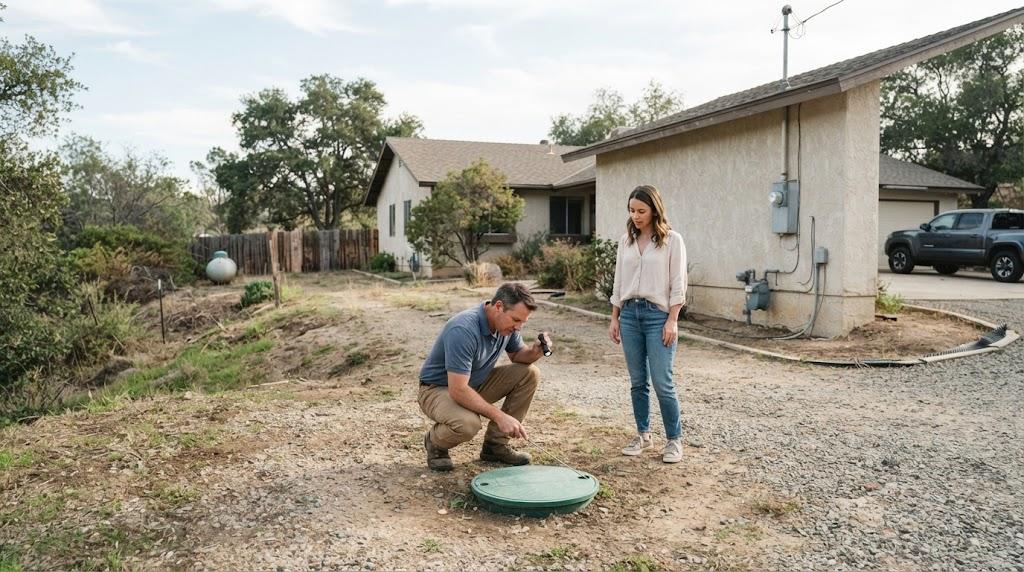
Septic Systems Are Common in Many Areas
A septic system is not automatically a problem. But it is a system you need to understand.
If you've only owned homes on city sewer before, septic feels unfamiliar. The basic idea is straightforward. Wastewater leaves the house, goes into a tank where solids settle out, and the liquid effluent flows into a leach field that disperses it into the ground. Routine maintenance usually means pumping the tank every few years and being thoughtful about what goes down the drain.
The system isn't complicated. The challenges come from age, neglect, and unknowns.
Deferred Maintenance Can Become Expensive
A lot of East County septic systems have been in the ground for decades. Some have been maintained well. Others haven't been touched in years. A failing leach field is one of the more expensive surprises a new buyer can inherit, and it's not always obvious from a quick walk through the property.
This is why a dedicated septic inspection matters. Not just a general home inspection that mentions the septic in passing. A real inspection includes pumping the tank, evaluating the components, and checking how the leach field is performing. If the seller has records of past service, that's helpful. If they don't, the inspection becomes even more important.
Most issues are identifiable during a proper inspection. You just have to make sure you're getting one.
Some Properties Operate on Well Water
Well water changes how you think about utilities and maintenance.
When you're on a municipal water connection, water is more or less a fixed cost and a fixed quality. When you're on a private well, you're responsible for the source, the pump, the storage, the filtration, and the testing. That doesn't make well water bad. Plenty of homes in Alpine and the more rural pockets around Lakeside have excellent wells that have served the property reliably for decades.
It does mean you're operating your own small water system.
Water Quality and Production Matter
During inspections, you want to look at a few things. Water quality testing tells you what's actually coming out of the ground, including any bacterial contamination, mineral content, or treatment needs. Flow rate testing tells you how much water the well can produce over a sustained period, which matters more than people realize, especially for properties with landscaping, livestock, or larger households. The pump, pressure tank, and any filtration equipment all have lifespans and should be evaluated.
Some properties also have storage tanks or share a well with neighbors. Shared wells aren't necessarily a problem, but they involve agreements between owners that you'll want to read carefully before closing.
Acreage Changes Ownership Responsibilities
Acreage creates freedom, but it also creates responsibility.
This is the part of East County ownership that buyers most often underestimate. A property looks beautiful in listing photos when the brush has been cleared, the trees are trimmed, and the fencing is in good shape. What those photos don't show is what it takes to keep it that way.
Brush management. Fencing repairs. Drainage maintenance. Tree work. Erosion control. Equipment to handle all of it, or contractors to do it for you. Seasonal cycles where some months require more work than others.
More Land Usually Means More Maintenance
I've worked with buyers who originally thought they wanted several acres, only to realize later that maintaining the property didn't quite fit the lifestyle they actually wanted. I've also worked with buyers who absolutely loved the extra space because they intentionally wanted room for animals, projects, or privacy. Both groups bought beautiful properties. The difference was how they planned to actually live on them.
The right amount of land for you depends on how you actually live, not on what looks impressive on paper.
If you're considering a larger parcel, be honest with yourself about what you'll do with it. Will you ride horses on it, or will it sit empty and grow weeds you have to clear every spring? Will you garden, or will it feel like a chore? The right size isn't about the listing photo. It's about your daily life.
Older Homes Often Need Closer Evaluation
Older East County homes often carry decades of modifications and updates.
A 1970s home in Alpine might have had additions in the 80s, an electrical upgrade in the 90s, new windows in the 2000s, and a remodeled kitchen last year. That layered history is part of what makes these homes interesting, but it's also why inspections matter more here.
Electrical systems, plumbing, HVAC, roofs, and drainage all have lifespans. Some of those systems get updated over the years. Some don't. The inspection process should look at all of it, not just the visible cosmetic finishes.
Unpermitted Work Is More Common Than Buyers Realize
I'm not raising this to alarm anyone. I'm raising it because it's a normal part of evaluating older properties out here.
Garage conversions, additions, second units, decks, electrical upgrades. Some of these were permitted properly. Some weren't. The county has clear processes for resolving unpermitted work, but those processes can take time and cost money, and they can affect things like appraisals and insurance.
When buying an older property, your agent should be helping you compare what's actually there with what's on record with the county. If there's a discrepancy, that's a conversation worth having before you remove contingencies, not after.
Commute Realities Matter More Than Buyers Expect
A property can feel perfect on Saturday afternoon and exhausting on Tuesday morning.
This is one of the most common pieces of feedback I hear from buyers a year or two after they move out here. The house is great. The lifestyle is great. The commute, for some of them, turned out to be more than they bargained for.
East County is not far from the rest of San Diego in mileage. But mileage isn't the right measurement. What matters is your specific commute, on your specific schedule, on the days you actually drive it.
Buyers Should Test the Drive
Before committing to a property in Alpine, Lakeside, or the foothills of El Cajon, drive the commute at the times you'd actually be driving it. A 7:30 a.m. weekday drive into Mission Valley feels nothing like a 1:00 p.m. weekend drive. Same with the return trip in the evening. Same with school drop-off if you have kids, or grocery runs in the middle of the day.
This isn't just about traffic. It's about whether the lifestyle still feels right after you've done the drive a few hundred times. Some buyers love the decompression of the drive home. Others find it wears them down. Both reactions are valid. You just want to know which one you'll be before you commit.
Why Buyers Often Love East County Anyway
After everything above, you might be wondering why anyone buys out here. The honest answer is that for the right buyer, East County offers a lifestyle that's increasingly hard to find elsewhere in San Diego County.
You can have privacy. You can have detached homes on real lots. You can have mountain views, quieter streets, and a slower pace. You can have flexibility with your property, room for projects, space for animals, or just space to breathe. There's a community feel in places like Alpine and the older parts of Lakeside that doesn't really exist in newer master-planned developments.
That lifestyle is real. It isn't marketing. The buyers I've worked with who feel settled and happy a few years in are the ones who chose East County intentionally. They knew what they were getting into, and the answer was a clear yes for them.
What Smart East County Buyers Usually Focus On
The buyers who do well out here tend to focus on a similar set of things during their search:
Insurance availability and cost
Septic and well inspections
Realistic maintenance expectations
Commute compatibility with their actual schedule
Long-term affordability, not just the monthly payment today
Usable land that fits how they actually live
Defensible space and brush mitigation
Whether the property functions well for daily life
That list is different from what less-experienced buyers tend to focus on. Buyers who run into problems are often the ones pulled in by cosmetic upgrades, the emotion of a mountain view, oversized parcels they won't maintain, or the short-term excitement of finding something that feels like a deal.
Both kinds of evaluation involve emotion. The difference is whether the emotion is grounded in how the property will actually work for you.
Common East County Buyer Mistakes
If you want a quick checklist of things to avoid, here's what comes up most often:
Ignoring wildfire insurance realities until late in escrow
Skipping or skimping on septic and well inspections
Buying more land than you can realistically maintain
Underestimating commute fatigue
Overlooking drainage or grading issues
Assuming all additions and improvements were properly permitted
Focusing only on listing aesthetics and finishes
Underestimating ongoing maintenance and ownership costs
Most of these are avoidable with the right preparation and the right inspections. None of them require you to be an expert. They just require knowing which questions to ask, and working with someone who has been through these properties before.
Why the Right Buyers Usually Love It Here
The buyers who tend to love East County long term are usually the ones who understood what they were buying from the beginning.
They knew the insurance situation before they signed. They knew the septic was in good shape, or they had a plan for it. They knew the commute and accepted it. They chose the right amount of land for their actual lifestyle, not for the photo it would make. The property delivered on what they actually needed.
That's the pattern I see again and again. Buyers who struggle aren't usually the ones who chose the wrong area. They're the ones who didn't fully understand what East County ownership asked of them before they committed.
FAQ
Is Alpine a good place to buy a home? Alpine works well for buyers who value privacy, detached homes, larger lots, and a quieter pace than coastal San Diego offers. Whether it's the right fit depends on your commute, your lifestyle, and how comfortable you are with the ownership considerations that come with semi-rural property.
What should buyers know about septic systems? A septic system is maintained infrastructure, not a problem by default. You'll want a dedicated septic inspection that includes pumping the tank and evaluating the leach field. Routine pumping every few years and being thoughtful about what goes down the drain keeps most systems running well for a long time.
Are wildfire insurance costs high in East County? They can be higher than in coastal areas, and availability has tightened in recent years. Some homes qualify with standard carriers, while others may need the California FAIR Plan combined with a wraparound policy. Getting quotes early in escrow is the best way to avoid surprises.
Is well water safe for homes? Well water can be excellent, but it depends on the specific well, the testing results, and the equipment. A proper well inspection includes water quality testing, flow rate testing, and an evaluation of the pump and any filtration or storage equipment.
What inspections matter most for rural properties? Beyond a standard home inspection, you typically want a septic inspection, a well inspection if applicable, a pest inspection, and depending on the property, evaluations of drainage, grading, roofing, electrical, and any additions. The exact list depends on the specific property.
Are East County homes more affordable? On a per-square-foot basis and a lot-size basis, East County often offers more home for the money than coastal San Diego. But affordability depends on more than purchase price. Insurance, maintenance, commute costs, and ongoing property upkeep all factor into long-term cost.
What are the downsides of owning acreage? The biggest one is ongoing maintenance. Brush clearing, fencing, drainage, tree work, and general upkeep can add up in time and money. The more land you own, the more honest you need to be about how you'll actually use it and maintain it.
A Final Thought
If you're trying to figure out whether East County ownership fits your lifestyle, how to evaluate rural or semi-rural properties, what inspections and costs matter most, or how to avoid expensive surprises during the buying process, those are exactly the questions worth thinking through carefully before you start writing offers.
Jacob and Kristin Menath help buyers work through those decisions clearly and without pressure. The goal isn't to talk anyone into East County. It's to help you decide whether it's the right fit for you, and if it is, to help you buy in a way that sets you up for long-term satisfaction.
Jacob Menath is a real estate agent in Alpine, CA serving San Diego County, helping homeowners make informed, confident decisions when selling their home and navigating major life transitions.
Menath Real Estate Team | Alpine, CA | Serving San Diego County



Have questions?
Menath Real Estate Team
Jacob & Kristin Menath, REALTORS®
2710 Alpine Blvd Ste K PMB 10106
Alpine, CA 91901
www.menathrealestate.com
CA DRE #01742516 | CA DRE #01522683